Please note that the information on this site is for my students only. Everyone is welcome to read it, but other faculty may have different rules.
Welcome to my Capstone Corner. The Capstone course will taught by three different faculty members, Profs. Shafai, Salehi, Ostadabbes, and DiMarzio. Prof. Shafai originally developed the Capstone program, and has led it very successfully for over two decades, so I will adhere quite closely to the rules that he has put together. Nevertheless, anything you see here is intended only for my own students. There will be some minor differences from the way in which other faculty handle the details.
I am pleased to share Prof. Kimani's Capstone site with you. He has some different information there that you may find very helpful. https://www1.coe.neu.edu/~jkimani/eece4790/
(15 Sep 25) Note that Microcenter will not allow the tax exemption unless you have a Northeastern Credit card with the number imprinted on it. I recommend you find a different vendor.
(24 Jul 25) Students should have access to the Capstone lab (and the main door to 009 HA with their ID cards. If it doesn't work, let me know. Each team should have one member visit Prof. Shafai at 12:00 Monday, 28 July, in the Capstone Lab to be assigned a bench and locker. Capstone Proposal presentations will be 11 and 12 August, Monday and Tuesday in the evening. Details will be coming. Capstone written proposals and peer evaluations are due before Noon on Wednesday 20 August.
(26 June 25)
Hello Everyone,
Welcome to Capstone. We will have a kickoff meeting with all students from all sections to start the Capstone Design course on Monday, 30 June, at 5:30pm in 108 Snell. I expect this meeting will last longer than one hour, but less than two. If you are a remote student, please arrange for someone to represent your interests at the meeting. Preferably you already have started to assemble a team and this person will be one of your teammates.
The purposes of the meeting are to
(1) Divide the students into teams. If you already have a team or part of a team, that's great. If you want to recruit more team members, this is a place to do so.
(2) Assign each team to a faculty member, based on matching interests, preferences, and workload distribution. If you already have a preferred faculty member, let that person know by email before the meeting. The faculty this year are Profs. Shafai, Salehi, Ostadabbas, and DiMarzio.
After this meeting, further capstone meetings will be arranged with your team and faculty member. My teams will have weekly meetings according to a schedule we will arrange for Summer 2 and another for Fall. The "class" times on your schedule are there for some purpose known to the registrar and you can ignore them.
The only other meetings will be at the end of Summer 2 when all students will present their proposals to all sections, and at the end of Fall semester at the all-day Capstone Design Competition. Dates for these meetings will be announced.
We all look forward to working with you.
--Chuck
Please help me with this section. If a link breaks, let me know. Engineering students are very resourceful. If you find something new and useful to the general Capstone population, let me know, and I'll consider adding it.
(7 July 2020) Prof. Kimani has a list of prior projects that you might find interesting at http://www1.coe.neu.edu/~jkimani/eece4790/PastProjects.html.
(13 July 2021) Here are links to three years of abstracts for
potential project ideas.
Abstracts_of_Capstone_Projects_April_2021.docx
Abstracts_of_Capstone_Projects_December_2020.docx
Capstone_Design_Abstracts_December_2019.doc
The ECE Department Capstone page has some more information about the course.
Sample course documents from previous students, are online at samples/index.html, each provided with permission of a team member.
Once a semester, I will request that you fill out the Peer Review Form .
Some reminders about reports are located at
http://www.ece.neu.edu/courses/eceg105/2003fa/reports.html
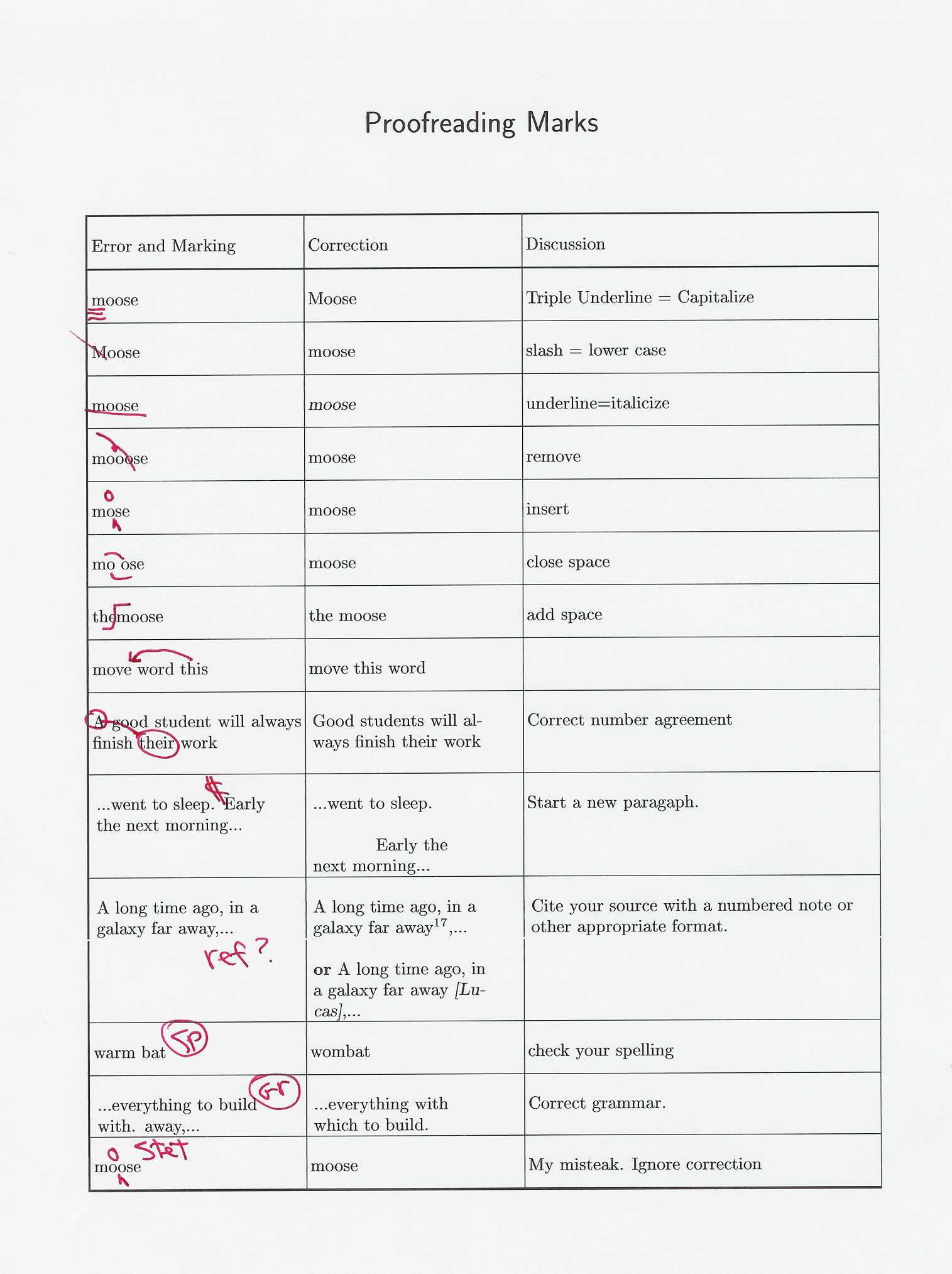
Proofreading marks I use in correcting papers are at
http://www.ece.neu.edu/faculty/dimarzio/10436.jpg
Here's some help with printed circuit boards.
pcb123
PC Express .
Bay Area Circuits
Here's a really small computer with a lot of capability. One of my teams
had great success with this. Gumstix
A couple DIY sites.
http://www.sparkfun.com and
http://www.nutsvolts.com
Let me try to answer some of the common questions.
What is Capstone all about? Capstone Design brings together as many as possible of the skills you have learned during your undergraduate career in ECE, and maybe even in other disciplines. During the Summer term you will prepare a proposal for your project. At the end of the summer term, you will present your proposal as a written document to me, and orally in front of the class. In the final term, you will implement your design. At the end you will present the results in a written report to me, and orally in front of the class and a group of external judges. At that time you will also demonstrate the project. Monetary awards are given to teams selected by the judges.
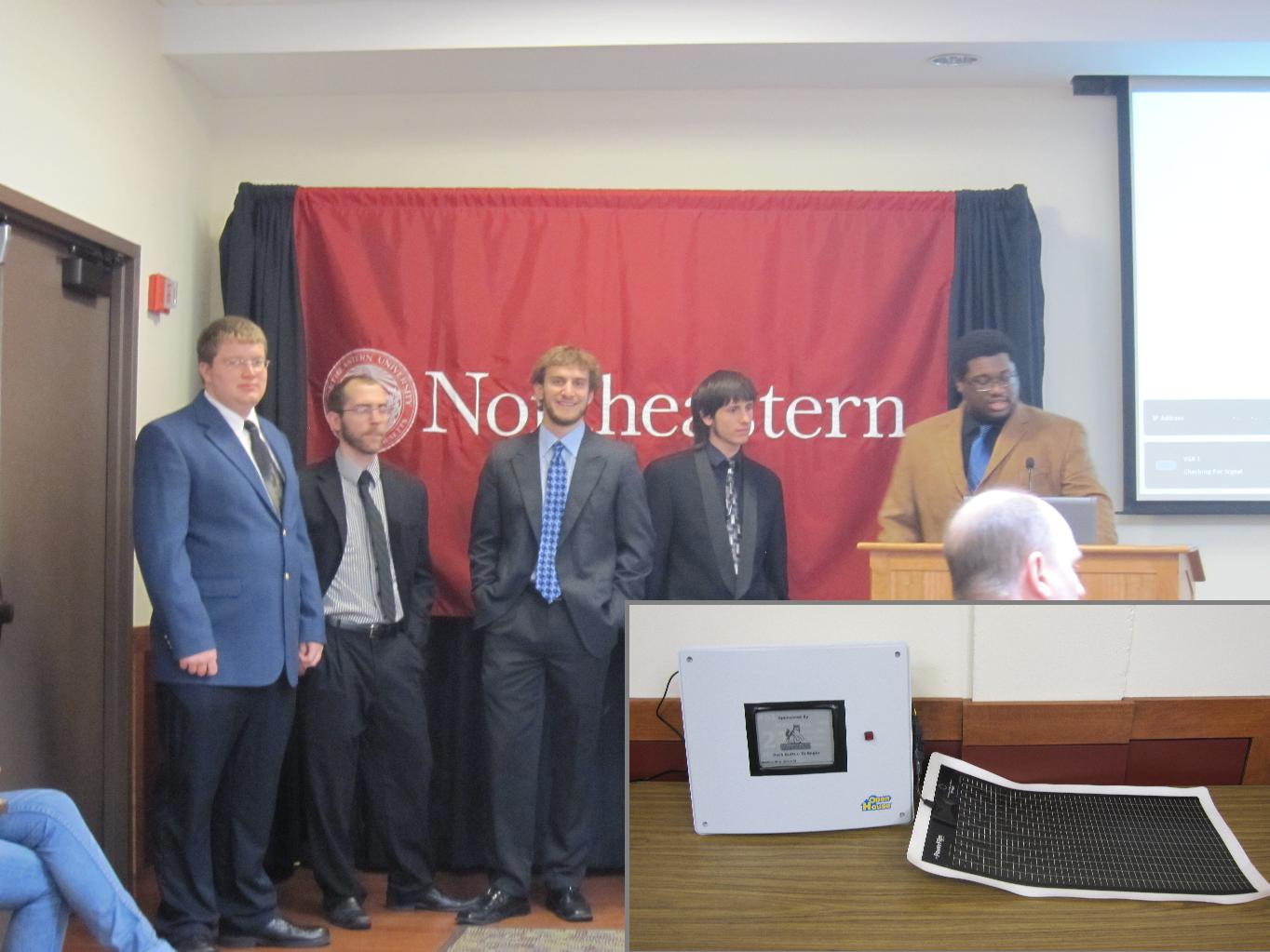
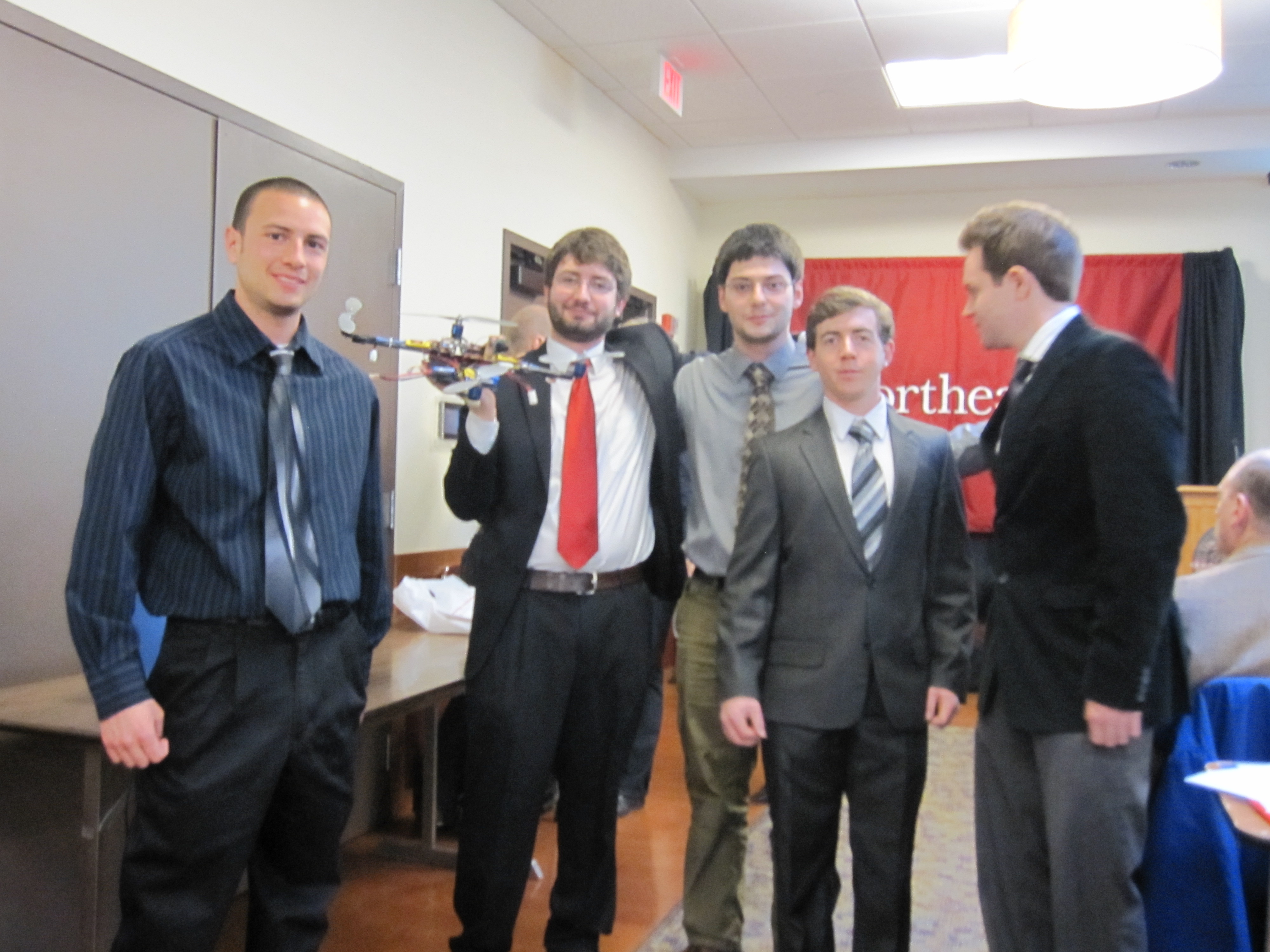
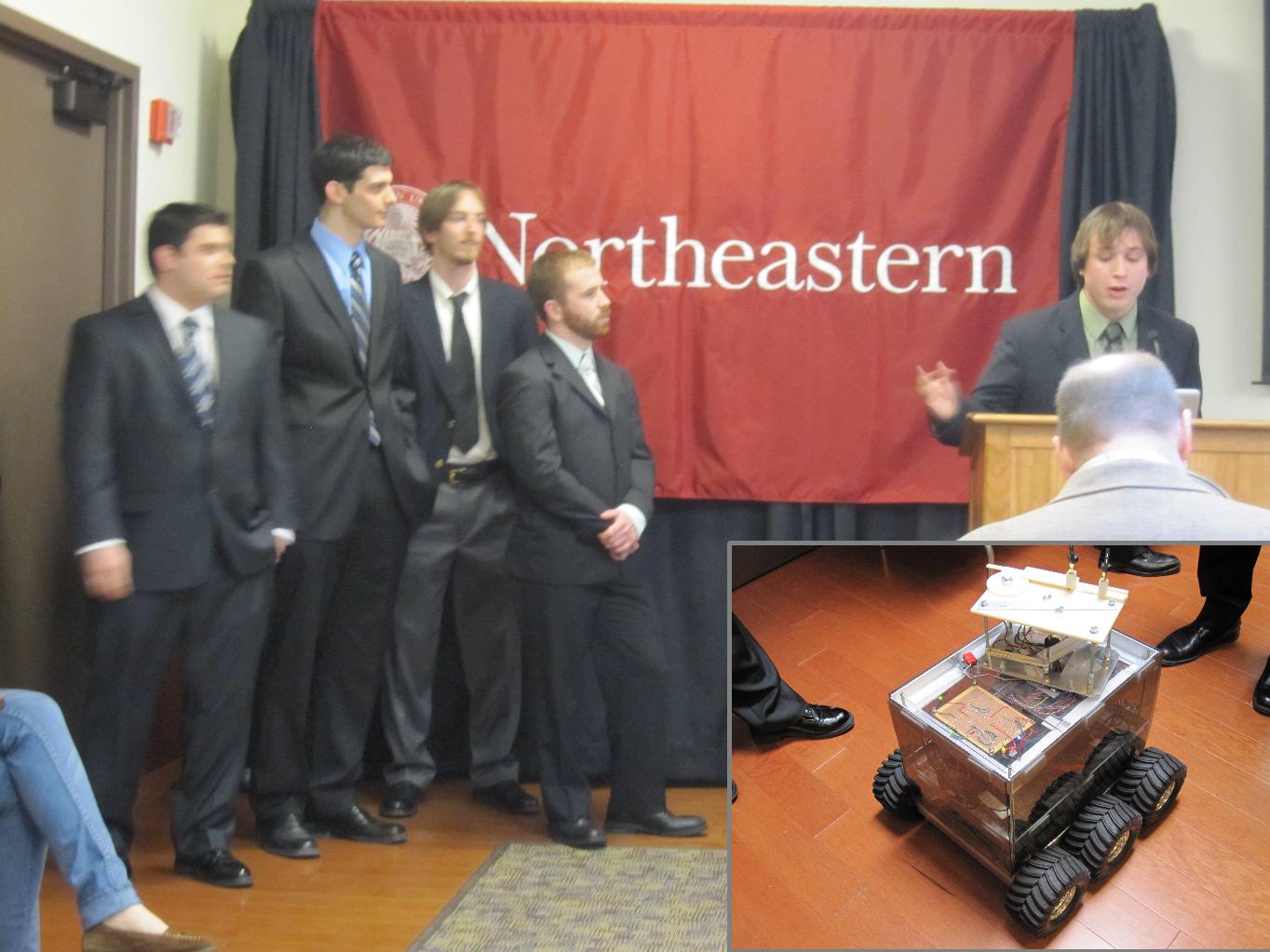
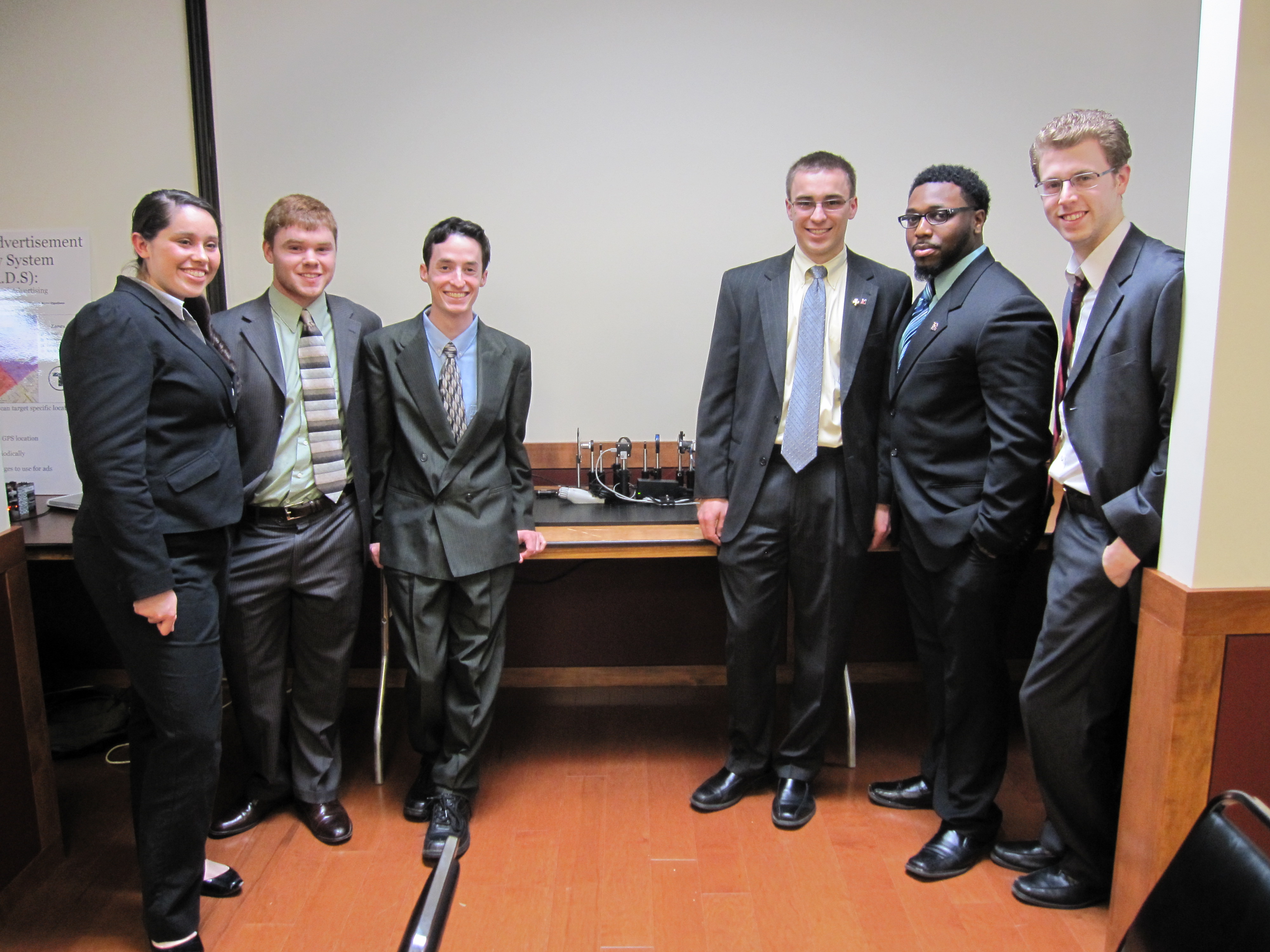
Below are some pictures from Spring 2011. After the pictures, I
have some more specific questions and answers.
| |
|
| |
|
I have the course on my schedule with a classroom and a meetng time. Is that for real? Only at the beginning of the term. There will be very few formal meetings of all the students in this course. Most of the activity will take place in weekly group meetings, where each group spends time with an advisor, reporting on progress and plans. We will arrange these meeting times to accomodate the academic schedules of all the group members. The whole group will meet a few times at the beginning of the summer II term, to establish groups, assign advisors, and select meeting times. At the end of each of the two terms we will all meet for oral presentations. These meetings will include the groups of all the faculty advisors. Don't make travel plans before the last day of classes, as that will likely be the presentation day.
So we only get to see the professor once a week? No. Our weekly meetings are a minimum. I expect a lot of informal contact through visits and email. First, it's my intention to wander by the Capstone Lab now and then during the white spaces in my schedule, and likely some evenings before I leave the campus. If you have regular hours your group plans to be working, let me know and I'll try to get down there to visit. I am very agreeable to discussing projects by email as well. However, it is your responsibility to initiate this. Let me know when things are going very well so I can see your accomplishments, or when they are going very badly so I can try to help find solutions. I will wander by the Capstone Lab on occasion to give you a chance for informal meetings. Please do not worry about approaching me. The Capstone course is considered to be one third of my activity for these semesters, so I expect to put in at least two hours per week per group.
What is expected? This is a 4-Semester-hour course, for
two semesters. Let's see what the workload would be for such a class:
| Normal Weekly Class Time | 120 min | 200 min |
| Weekly Outside Time | 360 min | 600 min |
| Total Time Per Week | 480 min (8 Hr) | 800 min (13 Hr) |
| Semester | 7 Weeks | 14 Weeks |
| Semester Workload | 56 Hr | 182 Hr |
| Total Workload per Person | 238 Hr |
What is a good project? I think the best projects are ones which cover as many aspects of your engineering education as possible; circuits, EM, signal processing, computer engineering, and perhaps something outside engineering. See the information below describing what the judges want to see. However, try to pick something you find interesting. You will work harder on it and your enthusiasm will show. The concept does not have to be original. Innovative design solutions are important, but an innovative concept is not. Commercial potential and market analysis are not normally part of the course. Cost effectiveness refers to your effective use of money to complete the project, not cost effectiveness in production or use.
Do we have to build something? Yes. A pure research project, that could be an excellent MS thesis, is not sufficient to be a Capstone project. The purpose of Capstone is to bring together as many different aspects of your engineering education as possible to design and fabricate a component, device, or system. A research project, no matter how complicated, does not qualify. A computer program might, but talk to me first.
We are doing a consumer project. Do we have to discuss the cost to the eventual consumer? No. Your budget should reflect the amount you have to spend to build your prototype for the capstone course. You do not need to discuss what the costs would be in production (or any other details about production). I am not an expert in this aspect of engineering, and I'm not going to grade you on it. There are issues such as certification, marketing, packaging, distribution, support, repair, etc. that contribute to the cost of a commercial product, and unless you have expertise in this area, it is probably best not to mention it. If the main idea of your project is to replicate a commercial product at lower cost, and you are not an expert in these matters, it might be best to consider another project.
My (coop employer|research advisor|mommy|etc.) would like to support my project. Is that ok? Yes. We are happy to have outside support for projects. They can contribute money, expertise, equipment, facilities, support, and more. However, the project must still be appropriate to the Capstone course, it must involve a team of students who all participate, and the presentation is made in public, so if there are potential issues about intellectual property, it's important that we talk about them early (preferably before the start of the course).
What do the judges want to see? This list is given to the judges prior to the competition. Individual judges may interpret these somewhat differently, but it is a good guideline.
1) Definition of a design problem
Description of the design
Clarity of the presentation
Degree of difficulty
2) Conceptualization of a solution
Means to achieve the design goal
Innovation and creativity
Feasibility of the solution
3) Implementation of the solution
Analysis and simulation results
Hardware and/or Software construction
Realization difficulty
Functionality of the systems
Cost effectiveness
Report and presentation
Where do we work? Most of the groups will do work in the Capstone Laboratory in 008 Hayden. You will be assigned a locker, a table, and a computer. There will be a good assortment of test equipment and tools for your use. You will probably get to know Steve and Eddie in the teaching labs, as they are good sources for equipment and supplies. Treat them well! Some of you may do projects that are sponsored by a faculty member or other source, and the sponsor may provide you with facilities.
How much money can we spend? The maximum reimbursement per team will be $700 (2025; subject to change in the future). Cost effectiveness will be considered in the judging. Try to find donations, loans, or other solutions for high-cost items. Contact faculty for help in this. However, do not bother vendors for small-cost items. Save your "points" for those things that really matter.
How do we buy things? New this year: We will explain this later. Do not pay sales tax!!! Get the NU Tax exempt number and use it. If you need to present the forms to a vendor, ask me.
How big is a group? The smallest groups should be four people, and the largest six.
How are groups formed and projects chosen? We will give you some ideas for projects the first day. You may also have your own. Sometimes a group is formed before the beginning of the course, with a definite idea of a project. or at least a general area of interest. Other times one or two students will have an idea, but no group. During the first day or two, we will give you an opportunity to get organized. If you have an idea, bring something to show the class to solicit team members. In picking a group, make sure you have a diversity of technical skills.
We think we have a really good idea. Can we patent it? If you are interested in this, contact me, and I'll put you in touch with the Center for Research Innovation. They will explain the options to you, and students have found them very helpful in the past.
One of the team members isn't performing. What can we do? The Capstone program is very much like life in industry. There are non-performers there too. Don't let one person sink the ship. A team of five can do a 6-person project. There will be an opportunity each term to rate your team members, and these ratings will be considered in the final grade. If there are problems of any kind, discuss them with me before they escalate.
What do we do at the summer presentations? In the summer, you present your proposal orally to the rest of the class (Prof. Shafai's students, Prof. Kimani's and mine). We'll give you some guidance on this during the term, but basically you discuss the problem you are trying to solve, your planned approach, budget and schedule.
Do we have to dress up for the proposal presentations? No. This meeting is for you and your fellow students. Dress as you would for any class.
What do we do at the Capstone Competition? There are details in the Milestones section below, but here's a quick summary. You will set up your project on the side of the room early in the morning, and plan to attend the whole day. When your turn comes, you will give a 10-12-minute presentation, answer some questions for the judges, and then take them to your table to demonstrate the project. There will be lunch, pictures, awards, and more pictures.
Do we have to dress up for the Competition? Yes. The dress code is business formal. Dress as you would for an interview. See the pictures above for examples.
Can my mommy come to the Competition? Of course your mommy can come! Friends and family are welcome. Unfortunately, because of the dynamic situation, we can not ensure that we will hold to the schedule. Some changes may be made even as late as the day of the presentations.
How do we get a locker? I will assign lockers and combinations.
What's the combination to the Capstone door? We will arrange for your NU ID card to swip open the doors to the lab.
How do we build things? You may use power tools after completing appropriate safety training. If you need more, contact me and we'll work on getting help from the machine shop and/or 3-D printing.
And what about grading? You will be graded on the milestones and deliverables listed below. Here is the gradesheet I will use for the reports and presentations. Check the syllabus to see how these figure into the total grade. About 80% of the grade will be based on team performance and 20% on individual performance.
For your convenience, I am compiling a list of important milestones. Those that contribute to the team grade are in yellow, and those that contribute to the individual grade are in cyan.
Weekly Reports: By 8PM the night before
your weekly meeting.
These can be short (one or two
paragraph) emails describing your progress during the past week,
and your plans for the future. Attach schedule charts and
technical diagrams as appropriate. Touch on the following
topics
These are to help me prepare
for the meeting, and I'm not grading them for style, so do not
put a lot of effort into making them attractive. Also, I'll cut
and paste them into a text file, so just write text inline in an
email rather than using word processing. If you spend more
than 15 minutes writing this, you are doing too much. Failure
to submit a report will affect your team grade.
Weekly meetings
Everyone is
expected to attend most of the meetings. there is some
flexibility, but if you are absent too often, it will affect your
grade. Quite likely there will be other meetings during the
week. Only the people who are involved in the meeting topic are
expected to attend these. However, if you are spending less time
on this than you would spend on a 4SH course, you are probably
falling behind. In the summer, keep in mind that your courseload
is halved and your workload per course is doubled.
Proposal Presentation Material: Submit an electronic copy of the material you used in your oral presentation, along with your written proposal. I do not need a paper copy of this.
Proposal: Your final proposal should describe the project in detail. Only an electronic copy is required. I do not need a paper copy. Here is a sample proposal .
Peer Evaluation 1 Each student must submit an individual participation report, using this form . I will use these in conjunction with my own observations concerning individual participation. Failure to submit an evaluation will lower your grade.
Continue Weekly Reports: By 8PM the night before your weekly meeting.
These can be short (one or two paragraph) emails describing your progress
during the past week, and your plans for the future. Include schedule charts
and technical diagrams as appropriate. These are to help me prepare
for the meeting, and I'm not grading them for style, so do not
put a lot of effort into making them attractive. Also, I'll cut
and paste them into a text file, so just write text inline in an
email rather than using word processing. If you spend more
than 15 minutes writing this, you are doing too much. Failure
to submit a report will affect your team grade.
Continue Weekly meetings
Everyone is
expected to attend most of the meetings. there is some
flexibility, but if you are absent too often, it will affect your
grade. Quite likely there will be other meetings during the
week. Only the people who are involved in the meeting topic are
expected to attend these.
Team--Specific Milestones: At your discretion.
I encourage you
to set up your own milestones, appropriate to your project, and integrate them
into your plan. For example, you might have a demonstration of software with
synthetic data, or a demonstration of an electronic subsystem with inputs from
a signal generator. These can be very helpful reality checks.
Mid--Semester Reality Check: Early November (Spring break for
other division).
At
this point you should have a working prototype. There may be some
missing functionality, but enough should be there so that we can see
that you are on track.
Decision on Participation in Competition: First week of December
Let me know if your group plans to participate in the competition.
At this point a working demonstration must be ready.
If your project is not ready, you may wish to present a week later.
Presenting later will not hurt your grade. In fact, it may improve
it if your project is "almost ready." However, you will not have a
chance to compete for the prize money. Do not embarrass yourself or
me. If you are not ready, then you are not ready.
Project Summary or Abstract.
Each group leader should submit a summary of the
group's project (One Page) in a .docx file. Please only use
this format, for
compatibility. This is the only time I'll ask for a .doc file.
Every other document you send should be in .pdf.
The top of the page page should be the title of the
project and the names of the group members. The rest should introduce
the project (problem formulation, analysis and the design).
Presentation Dry Run: Last weekly meeting before
competition.
This is the last chance to go through your
presentation with me, and make sure that everything is in order for
the judges.
Alternative Presentation: Finals Week.
If your project
is not sufficiently complete to be judged at the competition, we will
arrange an opportunity for you to present your work to some of the
capstone advisors in the following week. This opportunity is offered
in case your project is not quite ready on the day of the
competition. You will still have an opportunity to earn a good
grade, and the same standards of quality are expected on this date
as at the competition.
Gradable Material: Thursday of Finals Week.
Only an electronic copy is required, and it must be a single .pdf
file. Here is a sample
final report .
Presentation Material: Same time as final report: Submit an electronic copy of your presentation material, as used in your oral presentation, along with your final report. Please send a .pdf file.
Peer Evaluation 2:
Each student must submit an individual participation report,
using this form . I will use these in
conjunction with my own observations concerning individual
participation. Failure to submit an evaluation will lower your
grade.<
/font>
ABOUT THE BACKGROUND: My favorite winter passtime is
skiing. I put this background together from a detail of a photograph
taken at Park City, in 2003. There are four copies in different
orientations so that the tracks (and more importantly, the brightness
levels) line up as the pattern repeats.