Spoiled: How One Polymer Could Change the Way We Trust Our Food and Medicine
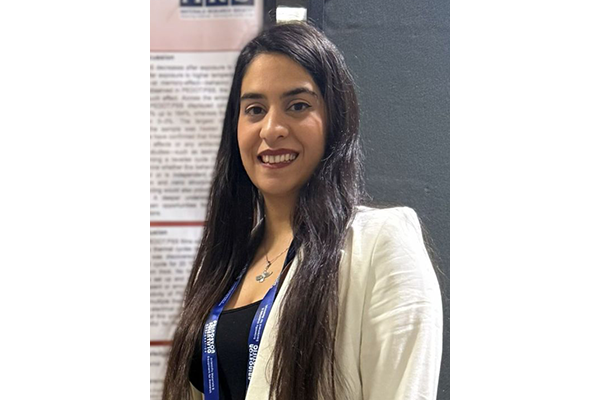
Tara Arjomandbigdeli portrait. Photo sourced from LinkedIn.
Tara Arjomandbigdeli, PhD’27, is an interdisciplinary engineering researcher at Northeastern’s eSOIL, a lab where she is developing a heat-sensitive polymer label designed to protect consumers by detecting when temperature-sensitive products like food or medication have spoiled. With plans to launch a startup from her research, she hopes to bring the technology to market—and eventually into every home.
Tara Arjomandbigdeli is pursuing a PhD in interdisciplinary engineering at Northeastern University, with a focus on electrical and mechanical engineering. She completed a bachelor’s degree in materials science and engineering at Sharif University of Technology, as well as a master’s degree in electrical engineering at Northeastern. As a child, Arjomandbigdeli was very interested in math, physics, and chemistry and growing up in a family of engineers she was inspired by the work they were doing. Also, her cousin completed a PhD in architecture engineering, and Arjomandbigdeli was fascinated by the dissertation process and making an impact on the scientific community.
Arjomandbigdeli developed an interest in electronic materials during her undergraduate studies, but there were not as many opportunities as she wanted to study this field at Sharif University. So, she looked out to the world and started applying to graduate programs. She was drawn to Northeastern initially because of its location in Boston—an academic hub of research opportunities—but it was the extensive lab resources and the accomplished faculty that solidified her choice. Among the stand-out faculty that she noted in her discovery were the Dean of the College of Engineering, Gregory Abowd, as well as Associate Professor Canek Fuentes Hernandez, who runs eSOIL (electronic surfaces and organic interfaces laboratory) at Northeastern.
Current research and mentorship
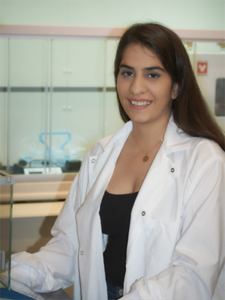
Arjomandbigdeli in the lab. Courtesy photo.
At eSOIL, Arjomandbigdeli is investigating the properties of a newly identified polymer with a key characteristic: it responds irreversibly to heat. Her current project applies this polymer to adhesive labels designed for temperature-sensitive products like meat or medication. The problem these labels address is a hidden one—if a product spoils due to heat exposure but is then cooled again, it may appear safe to consume when it not. Because the polymer’s reaction to heat is permanent, the label retains a visible indication of the temperature breach even after cooling, giving consumers a reliable signal that the product has been compromised.
Existing temperature indicators on the market are often made with costly materials, putting them out of reach for many vendors. Arjomandbigdeli’s research offers a simpler alternative—a thin polymer film that achieves the same function at a fraction of the cost, making widespread adoption far more feasible. The polymer’s environmental profile is another advantage she is actively exploring, with early indications suggesting it offers a more sustainable option than current materials. For Arjomandbigdeli, that combination of accessibility and environmental responsibility is central to what makes this research worth pursuing.
Distinguished Professor Vincent Harris has been a significant presence in Arjomandbigdeli’s doctoral experience. His Electronic Materials course came at a formative moment—one where she was actively reflecting on her strengths and adjusting to the differences between her previous education and the American academic system. Harris’s approach gave her the confidence to trust her abilities as a graduate student in a new environment. It clearly left a lasting impression: “being in his class was one of the best memories I had from Northeastern.”
Outside of research, Arjomandbigdeli served as a board member for the Iranian Student Association at Northeastern. Within this role, she helped organize and plan cultural, educational, and professional development events aimed at supporting Iranian students on campus. Through this organization, she found a sense of community at Northeastern and looks back fondly on her time with the group. Arojmandbigdeli also served as a board member for the Northeastern ECE PhD Student Association. She led the planning and execution of academic events designed to foster networking and mentorship opportunities, soft skills development, as well as cross-disciplinary collaboration among students and professionals. This experience also afforded Arjomandbigdeli with a chance to improve her communication skills.
Lessons, opportunities, and future plans
As she nears the end of her program, Arjomandbigdeli offers advice that is candid and drawn from experience. Early in her PhD, she took on multiple outside projects that pulled her focus away from her core research—a mistake she encourages others to avoid. Staying committed to one’s primary work, she suggests, is essential to building genuine depth and momentum. She also urges students to invest in networking, regardless of whether they plan to pursue academia or industry. A strong network and a clear, confident elevator pitch, she notes, are essential for turning connections into real career opportunities.
Arjomandbigdeli at the MRS 2025 conference.
Pursuing her degree at Northeastern has shifted Arjomandbigdeli’s vision for her future in ways she didn’t anticipate. She arrived committed to a straightforward path in industry, but exposure to Northeastern’s broader research ecosystem changed her thinking. Attending college-organized coffee hours introduced her to researchers who had built startup companies from their work, and connecting with industry professionals at the Northeastern National Academy of Inventors Fall Meeting 2025 gave her a clearer picture of how research translates into real market applications.
That vision has taken concrete shape: Arjomandbigdeli now hopes to launch a startup built around her polymer research in collaboration with pharmaceutical and food safety companies. Her ambitions are straightforward and deeply personal—she wants to bring a product to market that makes a tangible difference in people’s lives, and she wants every home to have access to it. For a researcher whose work began with a single polymer’s sensitivity to heat, the destination she has in mind is ambitious: safer food, better medicine, and technology that people can trust.