Advances Quantum Computing Communication Using Magnons
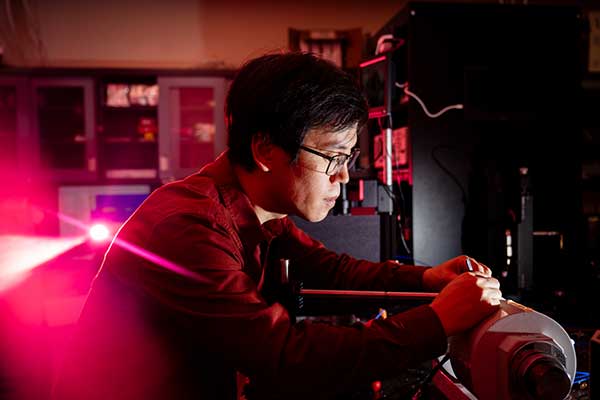
ECE Assistant Professor Xufeng Zhang is developing small-scale magnetic systems utilizing tiny quantum waves called magnons to help future quantum computers communicate with one another.
This article originally appeared on Northeastern Global News. It was published by Cesareo Contreras. Main photo: Xufeng Zhang, professor of electrical and computer engineering, works on nonlinear photonic devices and quantum optics in the Egan Research Center. Photo by Alyssa Stone/Northeastern University
Magnets could help quantum computers talk to each other, according to this Northeastern researcher
Xufeng Zhang is using magnets to make computers more power efficient at the quantum level.
The Northeastern professor of electrical and computer engineering recently published two papers over the past year highlighting small-scale magnetic systems he and his team developed that could help make computers much more power efficient in the future.
From placing over 300 hundred microwave sources on a single computer chip to creating a new approach to making his systems easier to deploy globally, Zhang is working on the cutting edge.
Central to Zhang’s research are magnons, tiny waves that travel through magnetic materials – including nickel and iron — when they are disturbed.
Northeastern Global News caught up with Zhang to learn more about magnons, his research, and its potential for the future of computing.
Read full story at Northeastern Global News