AI Innovation Through Diverse Collaboration
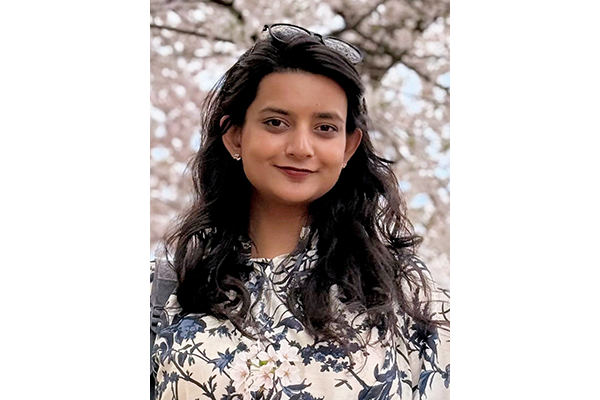
Portrait of Tooba Imtiaz. Courtesy Photo.
Tooba Imtiaz, PhD ’27, electrical engineering, is currently working at the Machine Learning Lab at Northeastern. With her skills, publications, and experience, Imtiaz will continue to research new innovations in the ever-evolving field of artificial intelligence.
Tooba Imtiaz is currently pursuing a PhD in electrical engineering at Northeastern University, having attained her bachelor’s degree in electrical engineering at the National University of Science and Technology in Pakistan. While in her undergrad studies, she was exposed to machine learning research, as well as plenty of programming courses, which Imtiaz especially enjoyed. One of her programming professors offered Imtiaz a summer internship, and this is where she solidified her interest in machine learning and computer vision.
Once she recognized the broad applications of machine learning, she decided to pursue a master’s, where her research focused on adversarial attacks in machine learning models. Imtiaz completed her master’s at the Korea Advanced Institute of Science and Technology in 2020, and decided that in pursuing a PhD in electrical engineering offered the most flexibility when it comes to working with AI.
Research
Northeastern became her top choice after her initial interview with the person who would become her PhD advisor, Distinguished Professor and Director of Experiential AI Postdoc Education and AI Faculty Jennifer Dy. This meeting convinced Imtiaz that she “resonated with the research itself and with her advisor’s vision of an impact-focused research approach.” Being in Boston was also a draw, as well as how Northeastern’s industry partnerships “opens a lot of doors for you.”
Throughout the program, Imtiaz has gained valuable skills as an independent researcher. She comments that, “It’s a unique kind of training that is hard to obtain from any other experience.” Having the discipline and perseverance to wrestle with a problem without the pressure to deliver a product is invaluable to Imtiaz, something she says she could not have gained had she gone straight to industry. She has also learned that creating a healthy working environment, maintaining work-life balance, and affecting a positive impact are non-negotiables in her career.
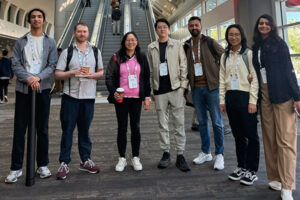
Tooba Imtiaz (far right) and her lab mates attending NeurIPS 2025. Courtesy Photo.
Imtiaz works at the Machine Learning Lab at Northeastern and maintains three distinct research domains in her work. The first, similar to her master’s experience, is strengthening machine learning models so they do not fall prey to adversarial attacks, as evidenced by her published research at Transactions on Machine Learning Research. Her second project focuses on continual learning in machine learning models. Continual learning allows an AI model to incrementally learn new tasks and adapt to new data over time, without forgetting previously acquired knowledge, mimicking human learning by building on past experience. She co-authored a paper on this topic at ICLR 2025. Her third project is in collaboration with Memorial Sloan Kettering Hospital in New York, on efficient 3D reconstruction of human skin for the detection and monitoring of skin cancers. This work entails building a continuous reconstruction of skin depths from reflectance confocal microscopy imaging, enabling medical specialists to visualize skin structures holistically rather than at isolated, discrete depths.
Time with Google
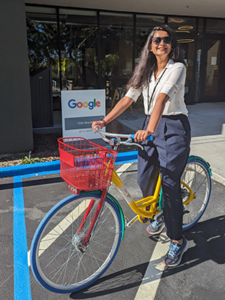
Tooba Imtiaz at her internship at Google. Courtesy Photo.
Imtiaz considers her extensive internships at Google to be key in her development. She started there in Summer 2024, where she worked on Project Starline (now renamed Google Beam), which is Google’s 3D telepresence technology designed to transform traditional 2D video calls into vivid, life-like, 3D interactions. She developed a feed-forward architecture for 3D reconstruction of scenes from long, high-resolution sequence of images in a single forward pass. She published this research in a paper titled “LVT: Large Scale Scene Reconstruction via Local View Transformers” at ACM SIGGRAPH Asia 2025. Imtiaz also completed another internship at Google working with the Pixel Biometrics AI Research team in 2025.
Grateful for the opportunity to work with “some of the most brilliant minds in the field” at Google, she was excited to see that her work had tangible applications and impact. She credits these internships as amazing learning opportunities, where she began with some foundational background in the domains, and the hands-on experience allowed her to deepen her expertise at an exceptional pace. Imtiaz appreciates working within an environment of collaboration while having access to various experts in the field.
In closing
Beyond her PhD, Imtiaz is excited to pursue an industry-facing research role at a tech company. She credits Northeastern’s collaborative approach—connecting PhD students with industry partners through internships and joint projects—with preparing her for this path. Many of her peers, she notes, have secured full-time positions at companies they worked with during their doctoral studies. “It’s a win-win situation,” Imtiaz declares, describing the impact of Northeastern’s collaborative mindset, as students get to engage with real-world challenges and companies are able to recruit talented engineers for their projects. Imtiaz is deeply grateful for access to state-of-the-art facilities and incredible resources while at Northeastern. She will continue to tackle the fast-paced AI industry using the skills she gained as an independent researcher at Northeastern and her commitment to advancing the future of technology.