Bridging the Brain and the Machine Through Engineering and Neuroscience
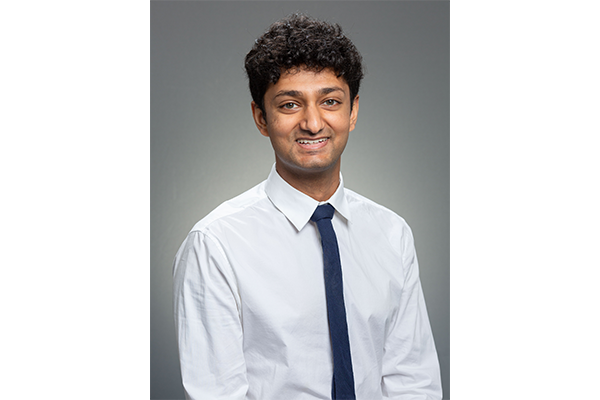
Sidharth Annapragada portrait. Courtesy photo.
Sidharth Annapragada, E’25, neuroscience and electrical engineering, is currently a research assistant at the Datta Lab at Harvard Medical School. With ambitions to pursue an MD-PhD, Annapragada hopes to work as both a practitioner and a researcher once he completes his education.
Sidharth Annapragada recently graduated from Northeastern University with a bachelor’s degree in neuroscience and electrical engineering. His interest in the field took root around fifth grade, when he became captivated by Lego robotics and, around the same time, by the way animals behave and move. He wanted to use that knowledge to make robots mimic animal behavior. As he got older, the passion held—but its focus sharpened. While many students in robotics turn to artificial intelligence to advance their systems, Annapragada became convinced that the truest path to intelligent machines runs through understanding the human brain itself. That conviction drew him to neuroscience, where he could study the brain closely enough to one day build hardware that works on the same principles. Knowing he would need a strong academic foundation to pursue this vision, he set his sights on a combined degree in electrical engineering and neuroscience from the start.
Heading into college applications with a PhD already in mind, Annapragada was drawn to Northeastern’s R1 research status and the breadth of research opportunities it offered. Discovering the Co-op Program deepened his interest—he saw it as a powerful way to build practical skills alongside his academic work. When a full scholarship offer came through, the decision was clear.
Experiential Opportunities
The majority of Annapragada’s hands-on experience has been at the Datta Lab at Harvard Medical School, where he completed two of his three co-ops. The lab studies how mice use their sense of smell to acquire information, with a particular focus on a behavior called the social transmission of food preference. The phenomenon works like this: if a mouse that didn’t originally like cinnamon smelled the spice on another mouse’s breath, it would subsequently develop a preference for it. To study how this happens, Annapragada performed surgeries, built sensors, and ran behavioral experiments to monitor the mice’s responses. In a later role as a full-time laboratory technician, his work shifted primarily toward data analysis and programming, with some continued experimental work. Understanding this process in mice has broader implications—as Annapragada puts it, “brains are brains,” and insights from mouse neuroscience can often be extended to humans.
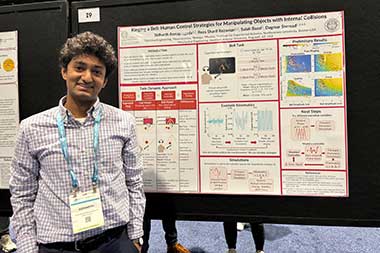
Annapragada presenting his research from the Action Lab. Courtesy photo.
His third co-op was through the AJC Merit Program, placing him at Northeastern’s Action Lab, where researchers study how humans control bells. Bells are what researchers call complex objects—humans manipulate the outside of the bell to influence the inside, which cannot be directly controlled. Understanding how people manage these two-dimensional dynamic systems has applications in robotics and prosthetics, informing the development of more capable and responsive technology. Annapragada worked across all aspects of the project—recruiting subjects, designing experiments, and analyzing data—and came away with a much fuller picture of what it means to “do science.” Managing all the moving parts of a research project, he says, gave him the confidence to pursue more independent work.
He is grateful to Northeastern—particularly his co-op advisor—for helping him establish the connections that led to his roles at the Datta Lab. The AJC Merit Program funding made his time at the Action Lab possible. Across all of these experiences, he has built the laboratory, experimental design, and data analysis skills that ultimately helped him secure a full-time position back at the Datta Lab after graduation.
Extracurriculars and Gratitude
Outside of class and research, Annapragada was involved primarily in two student organizations. As a member of the executive board of the Wireless Club, he helped facilitate the club’s workshops—covering topics like soldering and circuit board design—and found, to his surprise, that he genuinely enjoyed teaching. That discovery drew him to Neurons at Northeastern, the university’s neuroscience club, where he joined as a mentor for younger students. He guided them through the co-op search, course selection, and research opportunities, drawing on his own experiences. The role taught him something important: having expertise in a subject is only part of effective mentorship. How you deliver information matters just as much, and he developed his communication skills deliberately in order to make his knowledge more accessible.
Beyond university clubs, Annapragada launched his own engineering consulting firm during his undergraduate years, helping clients design products they wanted to manufacture. It was another avenue for applying his skills and staying curious—and he encourages other students to embrace a similar openness. Do your research, he says, but don’t hesitate to reach for an opportunity that interests you.
Two faculty members stand out as especially influential. University Distinguished Professor of Biology, Electrical and Computer Engineering, and Physics Dagmar Sternad, under whom he worked in the Action Lab in his sophomore year, was both an engaging teacher and a formative research mentor—helping him build his skills from the ground up, navigate research funding opportunities, and apply his engineering background to neuroscience questions. Professor Emeritus Joseph Ayers, whose courses Annapragada took and whose lab he worked in, was an intellectual inspiration. Ayers represents a distinctive school of thought in intelligent robotics—one that resists the AI-centric mainstream in favor of principles drawn from biological neural systems—and Annapragada found in him a kindred perspective. “He had the right idea about building thinking machines,” he says. Ayers also introduced him to the foundational concepts of the neuroscience field that continue to underpin his work.
Lessons and the Future
Annapragada’s advice to current students is to get clear on their goals sooner rather than later. Knowing what you’re working toward makes it much easier to build a path that actually leads there. On the research front, he strongly encourages students to seek paid positions whenever possible and to take full advantage of university grants and awards. Research is time-consuming, and holding down a separate part-time job on top of it is rarely sustainable. His broader advice is simply to “be aggressive”—in pursuing research opportunities, in the co-op search, in advocating for yourself. Self-advocacy, he says, is the one form of support you can count on consistently, both in college and beyond.
After completing his undergraduate degree, Annapragada plans to pursue a combined MD-PhD program, earning both degrees simultaneously. His long-term goal is to practice psychiatry or neurology while continuing to conduct research—remaining active on both the clinical and scientific fronts. His motivation is as clear as it is straightforward: help people, and push the field forward. With the depth of research experience he has built at Northeastern and Harvard, he is well prepared to begin that journey—and, one day, to offer real relief to those living with neurological and psychiatric conditions