Building from Scratch: A PhD Journey in Bio-inspired Robotics

Bibek Gupta portrait. Photo sourced from LinkedIn.
Bibek Gupta, PhD ’27, computer engineering, is developing morphing-wing robots at the Silicon Synapse Lab. From building bat-inspired systems from scratch, he’s mastered the modeling, control, and deployment skills needed to create robots that solve real-world problems—expertise he’ll bring to industry after graduation.
Bibek Gupta is currently pursuing his PhD in computer engineering with a concentration in robotics and controls. After completing his bachelor’s degree at the University of Mississippi in mechanical engineering, and rolling directly into this PhD program, he is combining his interest in understanding physical systems through mathematical modeling with his exploration of robotics during his undergraduate experience.
As a member of UMISS’s robotics club, Gupta developed a curiosity about controls, the foundational engineering discipline that enables a robot to interpret sensor data, make decisions, and execute precise physical actions. After receiving his bachelor’s and spending a year working in industry, he found himself drawn to Northeastern’s Silicon Synapse Lab, where research is focused on the full lifecycle of robotic systems—from concept and modeling to hardware deployment. In addition to recognizing how valuable this is towards a career in robotics, Gupta also appreciated the collaborative relationship Northeastern shares with other universities, like UC Berkeley. Additionally, his experience working with aerodynamics during his undergraduate degree translated perfectly to his current research.
Current research
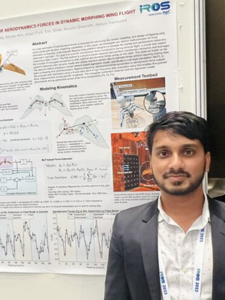
Gupta presenting his research at IROS 2025. Photo sourced from LinkedIn.
Gupta’s current research focuses on understanding and controlling aerial systems, specifically robots that can change their physical configuration while in flight. In particular, Gupta’s project involves building and deploying a bat-like ariel robot with wings that can change shape mid-flight. For the robot to successfully adjust its wing configuration while flying, it needs to accurately predict and respond to aerodynamic forces—the push and pull of air against its body. Gupta works on the modeling and controls systems that make this possible. He designs algorithms that account for these forces in real time, ensuring the robot can hover steadily and fly reliably as its wings morph. He recently presented his research at the 2025 International Conference on Intelligent Robots and Systems in Hangzhou, where he introduced new approaches for estimating aerodynamic forces on flapping aerial robots, including physics-based momentum modeling and data-driven learning methods.
He also works on a bio-inspired flapping bicopter—a flying robot with two rotors attached to wing-like structures that flap during flight. This unique design requires entirely new approaches to control and simulation. His role focuses on creating control systems that enable thrust vectoring, which allows the robot to change the direction of its thrust while airborne. He develops simulation frameworks to optimize these controls, then tests them virtually before eventually applying the algorithms to the physical robot.
Gupta is grateful for Northeastern’s research infrastructure, which, as he puts it, “provides extensive tools and innovative spaces to complete such meaningful work.” Here, through collaboration with other universities and industry partners, Gupta credits Northeastern’s vast network with expanding his resources and ability to learn from others.
Sage Advice
Gupta offers several pieces of advice for aspiring PhD students. First, build strong foundations in your field. For computer engineering, this means ensuring you’re knowledgeable in physics, dynamics, first principles, and modeling. As he puts it, “don’t worry about the complex concepts because these things can be learned when your basics are strong.”
He also encourages students to start research early. His lab includes many undergraduates who contribute meaningfully while developing valuable skills. “Starting early gives you a clear understanding of what you want to do, where you want to work, or what exact [niche] you want to work in,” he explains.
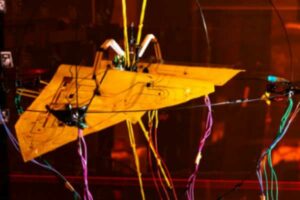
Robot inspired by bat wings at the Silicon Synapse Lab. Photo sourced from LinkedIn.
Equally important is choosing a lab with projects with projects that genuinely interest you. Motivation, Gupta emphasizes, is essential for completing a PhD. He comments, “if you end up doing something that isn’t interesting, it’s a disaster for a PhD.” Finally, he stresses the value of mentorship—whether from peers or senior academics. Having someone to look up to, he notes, makes a significant difference in your academic journey.
Appreciation and beyond
Gupta has benefited from strong mentorship at Northeastern, particularly from Associate Professor Alireza Ramezani, who leads the Silicon Synapse Lab. He views Professor Ramezani as a role model who followed a similar educational path, providing both inspiration and supportive guidance. He’s also enjoyed working with Professor Hanumant Singh, whose courses he found fascinating. Beyond individual mentors, Gupta appreciates the support of the PhD Network, which has provided funding for conferences and seminars.
After completing his PhD, Gupta plans to enter industry with a clear mission: translating his research into reliable, deployable robots that solve real-world problems. The skills he’s gained from building robots from scratch—from conceptual design to implementation—have prepared him for this next step. His experience and passion for robotics have prepared Gupta to excel in the field, ready to bring innovative solutions to whatever company he joins.