Shrivastava Awarded NIH R01 Grant for Creating Smart Implants for Managing Brain Disorders
ECE Associate Professor Aatmesh Shrivastava was awarded a $1.2M grant from the National Institute of Neurological Disorders and Stroke for “Transforming Brain Disorder Management through Ultra-Low-Power ML Implants.”
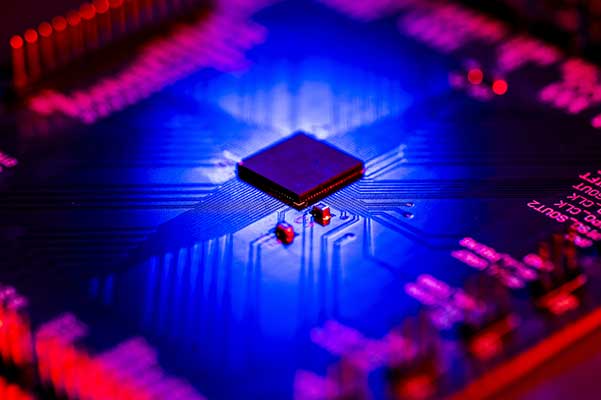
This article originally appeared on Northeastern Global News. It was published by Katya Poltorak. Main photo: Low-power chips developed in Aatmesh Shrivastava’s lab laid the groundwork for implants that can continuously track and analyze brain activity. Photo by Matthew Modoono/Northeastern University
This AI-powered implant chip could offer a deeper, longer look at faulty brain activity
A Northeastern professor is developing a low-power implant that uses machine learning to analyze brain signals in real time. With epilepsy as one test case, the goal is to uncover patterns that brief EEG tests miss.
The brain never clocks out. Whether you’re chatting with a friend, solving an algebra problem, reading a blog post or taking a nap, it’s buzzing with electrical activity. Nerve cells communicate this way, firing up to 1,000 signals every second.
A new device that Northeastern University electrical and computer engineering professor Aatmesh Shrivastava is developing with support from the National Institutes of Health aims to keep tabs on this activity as it unfolds. The chip tracks electrical signals under the scalp and uses AI to analyze the data and pick out meaningful patterns in real time.
Eventually, the device could detect signatures of neurological disorders such as epilepsy, which involves uncontrolled bursts of activity by groups of brain cells firing together. It could also help monitor Alzheimer’s and other conditions involving disrupted brain signaling, and provide insights into ALS, where the brain generates signals that don’t reach their destinations, Shrivastava said.
Scientists detect the brain’s signals with electroencephalogram (EEG) technology developed by German psychiatrist Hans Berger in 1924. It typically works by placing electrodes on the scalp to record waves of activity by large groups of cells.
While EEG provides a useful snapshot, signals overlap and messages get blurred, Shrivastava explained. It’s a bit like multiple people talking over one another on the same phone line.
Measuring under the scalp clears up the confusion by getting closer to the source.
“By going a little bit below, you can actually improve the quality of the signal,” Shrivastava said.
Shrivastava’s device will also record brain activity for much longer periods — days or even months at a time — compared to the typical 20 to 90 minutes that a standard EEG test lasts.
This approach can expose long-term patterns that short recordings miss, Ziv Peremen, chief executive officer of X-trodes Ltd, a company that develops wearable monitoring patches, explained. It can reveal “transitions into and out of abnormal activity, relationships to sleep and behavior, and early signatures that may precede clinical events,” he said.
Beyond capturing individual episodes, continuous monitoring could also provide a more nuanced picture of brain functioning and demonstrate long-term effects of medications, Ivan Gligorijević, chief executive officer and co-founder of mbraintrain.com, a company that develops wearable EEG technology, added.
But tracking for that long is practical only if the device uses very little power — after all, you can’t exactly plug a brain implant into the wall every night. Shrivastava’s previous work on low-power and self-powering chips laid the foundation for the new tech, which uses similar principles.
Read full story at Northeastern Global News