From Hanoi to Boston: Toan Gian and AI Innovations
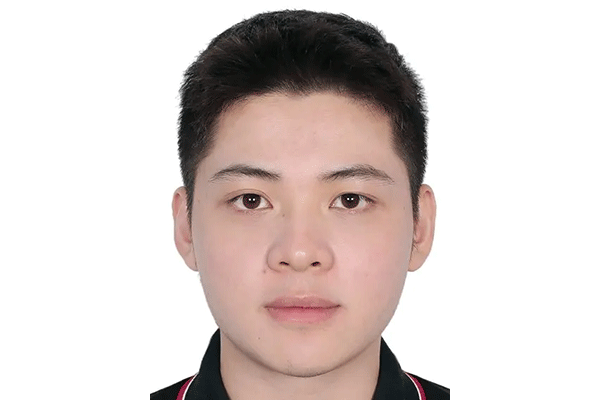
Toan Gian, PhD ’29, electrical and computer engineering, completed his bachelor’s in electrical and electronics engineering at Hanoi University of Science and Technology, then came straight to Northeastern to pursue his PhD. His academic journey continues to evolve while researching AI innovations at Mentis Lab at Northeastern.
Before Northeastern
Toan Gian, a PhD student in electrical and computer engineering, is currently working as a Graduate Research Assistant in Mentis Lab at Northeastern. Prior to arriving at Northeastern, Toan completed his Bachelor of Electrical and Electronics Engineering at Hanoi University of Science and Technology. He shared one of the biggest reasons why he chose this major was because as a high school student, he learned that the innovation of technology could be enabled to improve human life. Toan also strives for his work to have “real world impact,” leading to a career in industry where it can serve people’s everyday needs.
As an undergraduate, Toan did not have a perfect GPA, nor any achievements or rewards. Although he had some small publications at that time, he did not understand the research process until he became a research assistant at a lab sponsored by VinUniversity in Vietnam. There, Toan describes how he learned to perform proper research, read and write papers, and code, shaping his work ethic into what it is today. He worked there for seven months, eventually publishing his research to be presented at the European Conference on Computer Vision (ECCV) in Italy, 2024, which is one of the most prestigious conferences in Computer vision field.
At this conference, Milin Zhang (a current lab mate), approached Toan and started a conversation. This blossomed into a wonderful opportunity for Toan, as Zhang invited him to explore Mentis Lab because he valued the work Toan was doing in Hanoi. Toan was thrilled with the invitation, excited to apply to Northeastern as he perceived “…the electrical engineering [department] is one of the best in the US.” He also valued coming to Boston, calling it “the capital of education.” Toan was fortunate to be able to skip his master’s by completing more coursework at the beginning of his PhD program.
Settling in
While Toan initially encountered challenges due his inexperience with the English language, he found he could rely on his fellow lab mates to help him build his skills by conversing with him and correcting him when he made mistakes. Additionally, Toan described his gratitude towards his advisor at Mentis Lab, Assistant Professor Francesco Restuccia, stating that “He gave me time. He gave me a chance. He gave me the opportunity to learn and improve my research.” Toan now feels well-adjusted to his life at Northeastern.
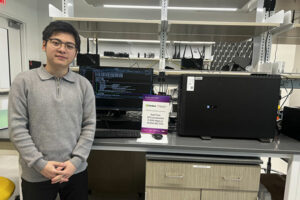
Toan Gian next to the lab’s supercomputer, used to make their AI models.
Toan and his Mentis Lab colleagues had their paper, “DE-HARL: Scalable Distributed Execution for Heterogeneous-Agent Reinforcement Learning” accepted at AAAI 2026, one of the world’s most prestigious AI conferences. Their research focuses on designing AI models—such as CNNs or DNNs—that can run efficiently on small mobile devices while maintaining high accuracy, challenging traditional assumptions about the systems AI requires to operate effectively. Notably, he and his advisor recently collaborated with professors at VinUniverisy and Trinity College to publish a paper at PerCom 2026, one of the best conferences for pervasive computing and communications. Toan emphasizes that Mentis Lab encourages students able to work in open-research environments, which helps students gain a broader perspective to approach cutting-edge technology.
Gratitude and perseverance
Toan attributes much of his success to Northeastern, through both the Mentis Lab and his PhD program. He explained that the high-tech equipment Northeastern makes available for his research allows him to do things that other universities do not have the resources for. Additionally, throughout his PhD program, Toan has been able to take a variety of classes, which he said improved his research. He described that when working on advanced topics within his research, one could be caught up in their own “niche” and forget the “foundational” information on the topic. Northeastern courses, such as Wireless Communication Network and Intro to Machine Learning, offered Toan both a refresher and additional knowledge that he now uses in his research.
Toan’s journey in academia has been worldly and innovative, and it is far from over. Despite his initial language challenge, through his own perseverance and the help of his peers, he is now flourishing. He continues to work hard in both his PhD program and as a research assistant, hoping to have “real world impact” through this holistic approach to his studies. Toan’s dedicated work will continue to develop new innovations in AI through his experience at Northeastern’s Mentis Lab.