Inaugural Summer Program Connects Engineering Students to Seattle Robotics Industry
Northeastern University’s inaugural seven-week “Summer In Seattle” program gave undergraduate engineering students hands-on experience in the Pacific Northwest’s vibrant robotics ecosystem through immersive coursework, industry site visits, and simulation projects.
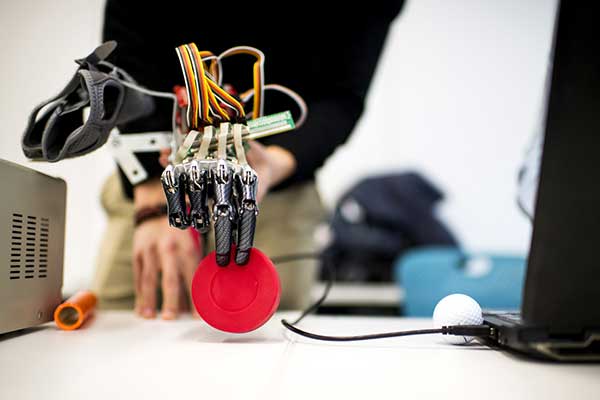
This article originally appeared on Northeastern Global News. It was published by Peter Rubinstein. Main photo: Northeastern Seattle’s robotics master’s program allows students to personalize their studies with courses on AI, machine learning and more. Photo by Adam Glanzman/Northeastern University
Northeastern undergrads given a crash course on Seattle’s vibrant robotics scene
Northeastern Seattle’s robotics curriculum equips students with the skills to focus their careers toward the in-demand robotics industry.
Seattle is known for more than its coffee, Douglas firs and proximity to the towering Mount Rainier. The city is also a notable leader in the modern robotics industry.
Companies like Boeing and Amazon, which are headquartered in Seattle, employ hundreds of thousands of robotic arms and autonomous systems. And a bubbling melting pot of small- and medium-sized companies use robots to enhance industries ranging from sustainability to national defense.
Northeastern University’s downtown Seattle campus, located next door to Amazon’s HQ, feeds this growing robotics ecosystem by educating the next generation of engineers and entrepreneurs through a Master of Science in Robotics program. An inaugural seven-week course also drew undergraduate students to the Pacific Northwest hub this summer, offering a variety of experiential learning opportunities and a taste of what Seattle can provide to those with ambitions in the space.
According to the U.S. Bureau of Labor Statistics, employment of mechanical engineers is projected to grow 9% from 2024 to 2034, much faster than the average for all other occupations. Jobs for computer hardware engineers and electrical engineers are similarly expected to grow 7% by 2034, both job categories that are essential to the automation and robotics space. And the demand for people versed in robotics is also projected to grow: The World Economic Forum reported in 2025 that it expects 58% of employers to reshape their businesses with robotics and automation by 2030.
“Computer science has always been this field where you need to keep on being agile and upskilling yourself, and I think of robotics as one of those next frontiers,” said Tamara Bonaci, a Northeastern computer science professor who has worked in Seattle’s robotics research scene since 2009. “In that sense, it feels like a robotics program in Seattle is the [right thing at the] right place at the right time.”

The nine students who attended the Summer In Seattle program brought with them a wide range of robotics experience. Photo by Elijah Henriquez and Karen Rojas
Northeastern’s Seattle-based robotics curriculum, and its extension into summer undergraduate programming, seeks to equip students with backgrounds in mechanical, electrical or computer engineering with the proper skillset to focus their careers toward robotics. It also allows students to personalize their studies with courses on smart robotic systems, AI, machine learning, control systems and more.
Like the Seattle’s master’s program cohort, the nine students who attended the Summer In Seattle program brought with them a wide range of robotics experience, interests and personal goals for the condensed course.
Among them was Benji Alwis, an incoming third-year student studying computer science and entrepreneurship who, before coming to Seattle, whose interest in robots had already led him to research them for nearly five years.
Read full story at Northeastern Global News