Innovation in the World of Wireless Communication
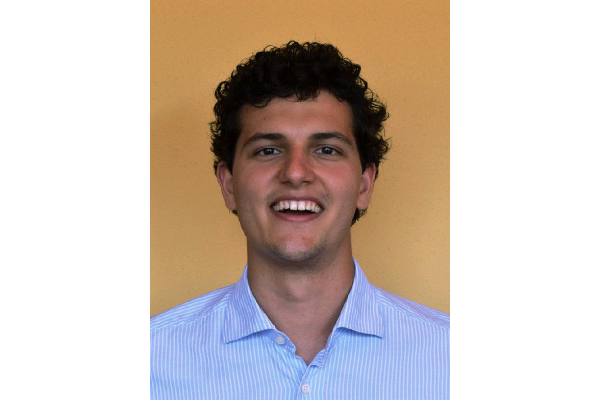
Portrait of Pietro Brach del Prever. Photo sourced from LinkedIn.
Pietro Brach del Prever, PhD’27, computer engineering, is conducting research at the Institute for Intelligent Networked Systems. With the support of Northeastern and a drive to push boundaries, Brach del Prever continues to dedicate himself to research that advances wireless communication.
Pietro Brach del Prever is pursuing a PhD in computer engineering at Northeastern University. Hailing from Italy, he earned both his bachelor’s and master’s degrees in mechanical engineering at the Politecnico di Torino. While in his master’s program, his focus shifted from mechatronics to robotics, though he had always been interested in computer science. Recognizing that computer engineering affords him broader application across many career paths, he honed in on wireless communication, a field that, as he puts it, “has a lot of impact on people’s everyday lives.”
While conducting research for his master’s thesis, Brach del Prever was offered a six-month research position by Professor Tommaso Melodia, Director of Northeastern’s Institute for Intelligent Networked Systems (INSI). While there, he studied cellular network support for UAVs, assisted with data collection, and discovered that he thrived in Northeastern’s research environment. Although he had not originally planned to pursue a PhD, the work proved engaging enough to change his course. He was also impressed with Northeastern’s culture of excellence—a place that, as he describes it, “pushes people to be great” academically—and to the community of dedicated peers he found beyond his own research group.
Research and red tape
Brach del Prever currently works at INSI as a doctoral researcher. His research centers on the Open Radio Access Network (O-RAN), where he is developing a conflict detection and mitigation system to optimize these networks. The work deals directly with intelligent agents, such as AI-driven applications and software from multiple vendors, which can conflict with one another due to a lack of coordination. His research aims to prevent and manage such conflicts as they arise.
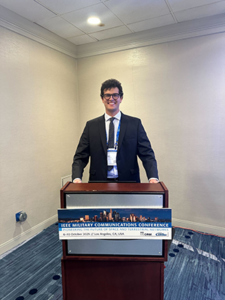
Brach del Prever presenting at IEEE MILCOM conference. Courtesy photo.
Beyond his O-RAN work, Brach del Prever presented a paper at IEEE MILCOM 2025 in Los Angeles, co-authored with Distinguished Professor Josep Jornet and other colleagues. The paper explores the challenges of communicating with satellites using terahertz frequencies, which can carry large amounts of data but require antennas to point with extreme precision. Since practical hardware has physical limitations in how fast and accurately it can track a moving satellite, the study examines how these imperfections affect the quality of the connection, and provides guidance for designing more reliable satellite communication systems in the future.
When it comes to institutional support, Brach del Prever is emphatic: “My work would not be possible without the infrastructure at Northeastern.” Wireless communication research is tightly regulated; transmitting on specific frequencies requires permits that are often costly and difficult to obtain. At Northeastern, however, he and his team have access to the necessary rights and licenses to transmit and run experiments. A key piece of this infrastructure is Colosseum, a large-scale wireless channel emulator hosted at Northeastern’s facilities in Burlington, Massachusetts. Installed by the Institute with the university’s support, Colosseum allows researchers to create realistic cellular network environments for experimentation.
Northeastern also provides access to prior research and facilitates collaboration with partners in academia, industry, and government. This is especially critical in wireless communication, a field built on shared standards that enable interoperability across vendors, operators, and countries. A technology or solution, no matter how innovative, only succeeds if it is widely adopted and incorporated into these standards. As Brach del Prever explains, “If it’s not adopted by everyone, it’s not a good technology, it’s not a good solution.” For this reason, collaboration with a broad range of stakeholders is not optional for him, it is fundamental to making meaningful contributions to the field. While navigating the regulatory landscape alongside his research presents challenges, the impact of the work makes those hurdles worthwhile.
Reflection and gratitude
Over the course of his program, Brach del Prever has gained valuable lessons in project management and problem-solving. He describes problem-solving as both his favorite and most challenging aspect of research, noting that a PhD demands that you “engage 100% of yourself into one task.” While many evenings leave him exhausted after long hours in the lab, it is precisely these challenges that keep him engaged.
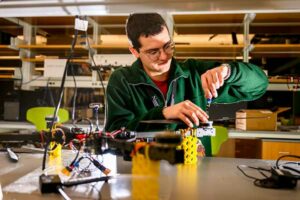
Brach del Prever working in the lab. Courtesy photo.
One professor he particularly admires is Professor Melodia, whose vision and passion have been instrumental in shaping both the Institute and the broader field. Brach del Prever is inspired by what Melodia and his colleagues built: just fifteen years ago, it was nearly inconceivable for a university lab to conduct the kind of hands-on cellular network research that INSI carries out today. Through a combination of university support, national grants, and industry partnerships, Melodia turned that vision into reality, establishing the Institute as a reference point for researchers worldwide. It is this kind of leadership that continues to attract talented researchers to the Institute from around the globe.
Future decisions
As he approaches the later stages of his program, Brach del Prever finds himself drawn to life in academia and its freedom to explore new directions. His internship at AT&T gave him a closer look at industry research and the role of product development in the research process. Having experienced both worlds, he sees more similarities than differences and remains open to pursuing either path after completing his PhD. Further down the road, he is considering launching a startup to pursue his own venture, though he wants to gain more experience first.
Regardless of the path he chooses, Brach del Prever is committed to improving and optimizing technology in ways that enhance quality of life. Society and technology, he believes, are tightly intertwined. With the experience gained at Northeastern and an enduring commitment to innovation, he aims to help usher in a new era of wireless communications.