Paying It Forward: Four Northeastern Engineers on Service, Purpose, and Giving Back
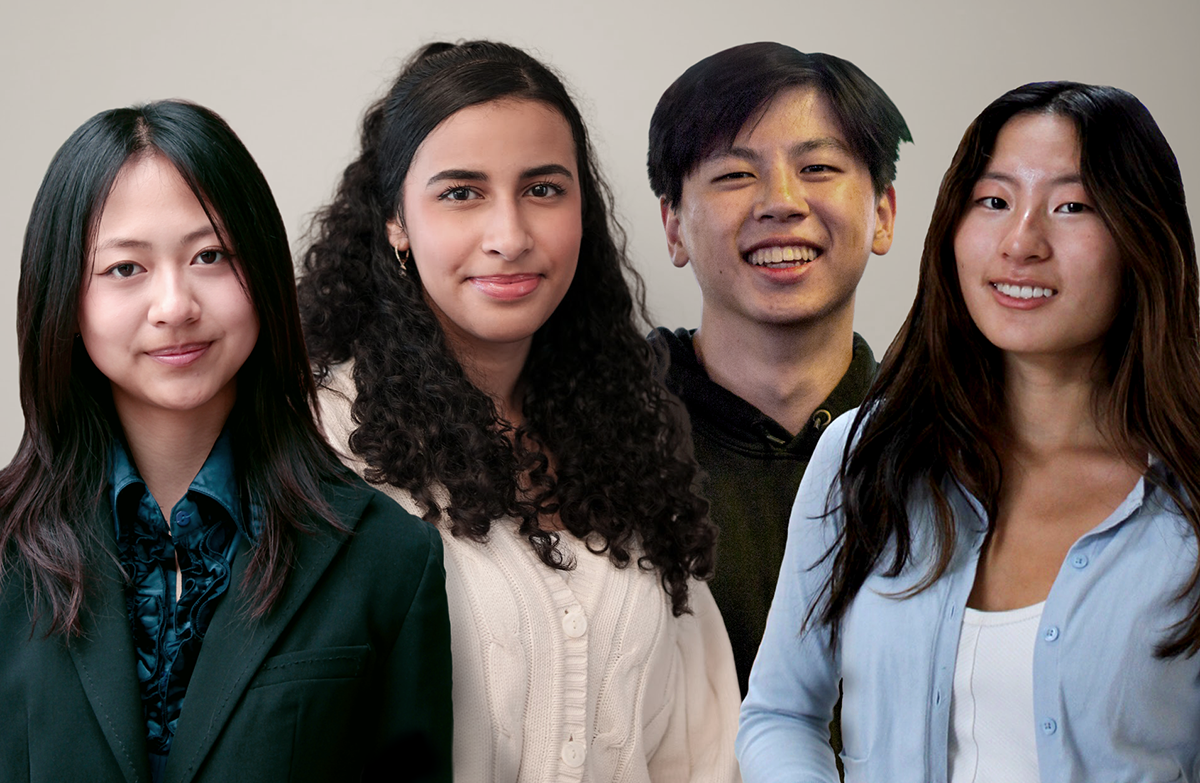
Portraits of Clare, Hebat, Jimmy, Mia (in order). Courtesy photos.
Four Northeastern engineering students — Clare Chi, Hebat Elkacemi, Jimmy Cheung, and Mia Filardi—were selected this year as Patrick P. Lee Scholarship recipients, chosen not for accolades alone but for their commitment to bringing others along with them. From teaching robotics to Boston schoolchildren to leading civic engagement programs and organizing voter registration drives, each has found a distinct way to turn their education outward. Their stories reflect a simple but demanding idea: that what you receive, you owe to others.
Clare Chi is finishing her engineering degree while running a research project on leukemia, teaching robotics to Boston schoolchildren, and arranging live violin performances for hospital patients. Hebat Elkacemi is completing a radio frequency co-op while organizing professional conferences for engineering students who need the same networking lifelines she once needed herself. Mia Filardi went back to lead the civic engagement program that overwhelmed her with opportunities as a freshman. Jimmy Cheung spends his free time making strangers feel genuinely welcome.
These four are this year’s Patrick P. Lee Scholarship recipients from Northeastern University’s College of Engineering—a scholarship that, by design, is not simply looking for academic standouts. Each arrived at Northeastern by a different road, and each is heading somewhere different after graduation. But a common thread runs through all four of their stories: the impulse, even in the middle of demanding coursework and competitive co-ops, to turn around and hold the door open for someone behind them.
Finding the Path
None of the four arrived at their current major in a straight line. Clare Chi, E’26, biochemistry and bioengineering, came to Northeastern intending to become a doctor, drawn to Boston partly because of its thriving biotech industry. A pivot away from pre-med led her instead to the Spatial Lab, where she works under Assistant Professor of Bioengineering Christa Haase, studying acute myeloid leukemia and the bone marrow microenvironment—and eventually toward plans for a PhD. She also credits Associate Professor of Bioengineering Sara Rouhanifard as a formative influence on her academic path. “What I wanted to do evolved,” she says, “but my reasons for doing it didn’t.”
Mia Filardi, E’27, mechanical engineering and bioengineering, followed a similar arc—originally pre-med, then redirected by an Engineering Day at her high school that showed her a broader canvas. She points to her first-year Cornerstone course with Associate Teaching Professor Andrew Gillen as an early anchor: it gave her a clearer sense of what engineering actually looked like in practice. “It’s never too late to change your mind,” she says now, advice born from having redrawn her own plans more than once. She is completing a final co-op at Johnson & Johnson, improving medical devices already on the market—work she values precisely because she can hear from the patients her efforts reach.
Hebat Elkacemi, E’27, electrical and computer engineering, came to engineering through an unlikely door: her high school robotics club, which she joined as a senior, years after she had already planted roots in community advocacy. Jimmy Cheung, E’27, electrical and computer engineering, grew up in Texas, where his parents ran a restaurant and instilled in him the value of education. He chose Northeastern after being drawn east by its reputation for placing graduates into meaningful careers—and by the energy of Boston itself.
Service as a Habit, Not a Résumé Line
What distinguishes Patrick P. Lee scholars is that their service rarely feels strategic. For Elkacemi, civic engagement began well before college—canvassing for local elections, organizing voter registration drives in multilingual communities, and eventually advocating on the steps of the Massachusetts State House for equitable funding for student robotics programs. That last effort helped secure resources for her own high school team, which, despite chronically limited funding, was ranked second in the world the year she advocated for it.
At Northeastern, Elkacemi has continued in that spirit as secretary for the New England region of the National Society of Black Engineers and as a member of the Black Engineering Student Society, where she helps plan professional conferences and creates the networking access that she herself benefited from early in her studies. Her co-op at the Kostas Research Institute has extended that same principle into her technical work, embedding her in a research environment that connects engineering to real-world problems. She is candid about what the Patrick P. Lee scholarship has meant to her as a first-generation college student: the financial relief, she says, freed her to be present in the communities she cares about rather than spending that energy managing financial stress.
Filardi’s instinct for service has likewise been a constant. She arrived at Northeastern determined to get involved in service opportunities, so she joined the Alliance of Civically Engaged Students (ACES)—a program combining weekly volunteering with civic education. After a demanding first week that tested her considerably, she returned the following year not as a participant but as a peer mentor and educator, teaching her mentees about redlining, immigration policy, and what it means to work with communities rather than simply for them. “I just want to help people,” she says, in a way that sounds less like a mission statement and more like a simple statement of fact.
Chi has found her own ways to knit together the threads of her interests. Through her volunteer work at Brigham and Women’s Hospital and her involvement with Northeastern’s chamber music program—she has played violin since age five—she helped arrange a live performance at the hospital for patients and staff. She hopes to make it a semesterly tradition. And through Roxbury Robotics, she joined fellow engineering students who traveled to after-school programs across Boston to teach elementary and middle school students robotics skills many of them would not otherwise encounter.
For Cheung, the form service takes is more relational than programmatic. As a leader in InterVarsity, a Christian ministry on campus, he has developed what he describes as the skill of being “authentically inclusive to complete strangers”—the kind of presence that makes people feel genuinely welcomed rather than merely processed. He thinks of it less as an extracurricular and more as a practice he intends to carry forward.
The Weight of Support
All four speak with genuine feeling about what the scholarship has meant to them—and notably, they speak of it in terms that go well beyond money. The financial relief is real and they say so plainly. But what they linger on is something less tangible: the sense of being believed in.
Cheung describes the scholarship as having given him the freedom to take professional risks he might otherwise have avoided—to pursue the co-op that interested him most rather than the one that felt safest. Filardi found not only financial support but confidence: the recognition that she belonged in engineering at a time when she wasn’t entirely sure she did. Elkacemi recalls being moved by the opportunity to meet Patrick Lee himself and hear his story firsthand. His belief in her, she says, reminded her to believe in herself.
Chi echoes the sentiment about the network the foundation provides—graduate students, undergraduates, professionals—all people, she observes, with “similar ambitions working hard in their fields.” That sense of belonging to something larger than one’s own graduating class is, for all four scholars, part of what the award actually confers.
What Comes Next
Their futures are varied. Chi will be pursuing a PhD in bioengineering at Rice University, with a focus on drug delivery and a long-term vision of contributing to human health. She mentions, with some amusement, that the Harvard Summer Ventures in Management program she completed on a whim has left her entertaining the idea of an MBA one day, too. Filardi will remain in the medical device industry, motivated by the direct line between her work and the patients who benefit from it.
Elkacemi plans to pursue graduate study before entering the tech industry, where she imagines herself in a managerial or operations role—though always, she is clear, as someone who continues to mentor and build community. Cheung, completing his third co-op at NK Labs after an earlier placement at Texas Instruments, is sharpening his skills as an embedded systems engineer. He credits Teaching Professor of Electrical and Computer Engineering Iman Salama as someone who helped shape his academic direction and gave him a clearer sense of where he wants to go. His career philosophy, he says, is straightforward: do the work, stay prepared, and trust that the right opportunities will come.
What all four share is a disposition that the Patrick P. Lee Foundation recognized and chose to invest in: not just the drive to achieve, but the orientation toward others that makes achievement mean something. They were not selected because they were the loudest success stories in the room. They were selected because, in the middle of everything they are navigating themselves, they have consistently made room for other people.
That is, by any measure, the point.