Restuccia Receives Prestigious PECASE Award
ECE Associate Professor Francesco Restuccia was awarded a $1M Presidential Early Career Award for Scientists and Engineers to develop mathematical frameworks that make wireless systems and AI models more reliable by accounting for uncertainty and ignorance.
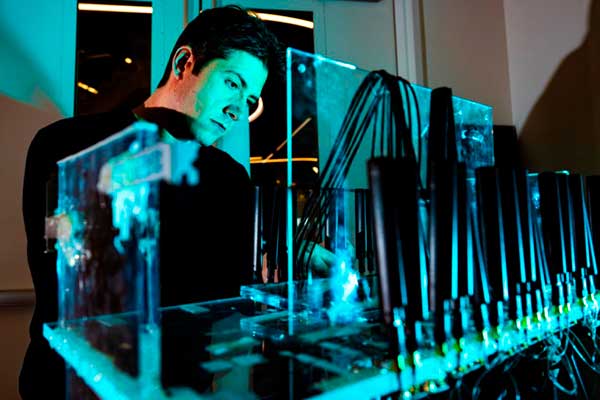
This article originally appeared on Northeastern Global News. It was published by Cesareo Contreras. Main photo: Northeastern electrical and computer engineering professor Francesco Restuccia works in his lab in EXP. Photo by Alyssa Stone/Northeastern University
This award-winning Northeastern professor is working on making AI and wireless systems more reliable
Francesco Restuccia has been awarded a Presidential Early Career Award to improve the reliability of wireless systems and AI models.
In the AI age, industries from biotechnology to defense are relying on autonomous systems with increasing frequency.
One clear example is the use of drones that do not rely on direct human guidance to deliver packages, explained Francesco Restuccia, a professor of electrical and computer engineering at Northeastern University.
These aerial machines regularly navigate areas that could look different from the data their artificial intelligence systems were trained on, he said. That’s dangerous because the drones may face obstacles that would be difficult for them to foresee, like hidden walls.
At Northeastern, Restuccia will develop new mathematical frameworks that could help these machines operate more smoothly in complex environments.
“Over the years, I’ve discovered that a lot of these systems are very uncertain,” he said. “They are surrounded by uncertainty in their data, in their communication systems, everywhere. But there is no principled way of characterizing that uncertainty. This is what my project fills out.”
To support this research effort, Restuccia has been awarded the Presidential Early Career Award for Scientists and Engineers, one of the highest honors awarded by the federal government given to young researchers in the U.S. He was nominated for the award by the U.S. Army Research Office.
As part of the award, Restuccia, 38, has been awarded $1 million to pursue the five-year project.
Restuccia will work on building on Classical information theory, a framework developed in 1948 useful for ensuring reliable and consistent information sharing between tele-communication systems.
Read full story at Northeastern Global News