Taking Chances and Discovery with Adarsh Salagame
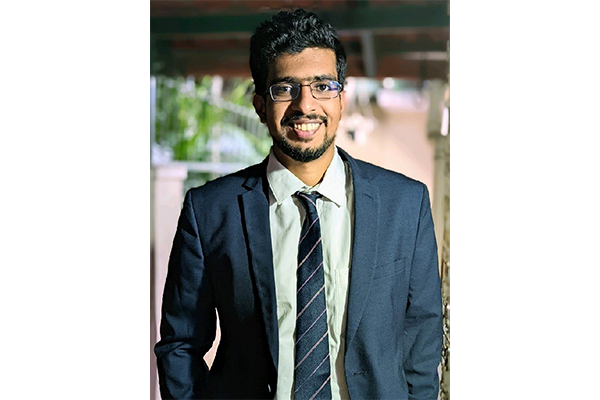
Portrait of Adarsh Salagame. Photo sourced from LinkedIn
Adarsh Salagame, PhD ’27, computer engineering, works in the Silicon Synapse Lab at Northeastern. After discovering the expansive applications of robotics research, Salagame continues to explore all aspects of robotic systems, feeding his drive for success in the field.
Adarsh Salagame is working toward his PhD in computer engineering. While pursuing a bachelor’s degree in electrical and electronics engineering at the Birla Institute of Technology and Science, Salagame has always had an interest in building things, but he was not quite sure what area of engineering he wanted to nurture.
A chance encounter
He came to the field of robotics by chance. During the last year of his undergraduate studies, Salagame’s class was automatically assigned internships based on a large preference list. He ended up getting a robotics internship with a company that was relatively low on his list. “Back in 2019, robotics in India wasn’t really much of a thing, so I didn’t know this was a field you could actually build a career in,” Salagame explains. After just six months of delving into robotics, Salagame began to recognize robotics as a viable career path. He found that with robotics he did not need to choose between different aspects of engineering, rather, he could do it all.
After undergrad, Salagame worked for a year at the Indian Institute of Science, where he built different kinds of autonomous drones. Through this experience, he explored the control and perception side of robotics. Ultimately, this led him to Northeastern, where he completed his master’s degree in robotics in 2022. He was drawn to Northeastern for its large faculty and myriad resources in robotics. Also, Salagame comments that “…the research focus felt a little more applied,” compared to other robotic programs that seem to focus more on theory over practical.
Salagame was planning to return to industry after his master’s, but changed his mind while working on his thesis with Associate Professor Alireza Ramezani at Northeastern’s Silicon Synapse Lab. Their research focused on building robots from scratch, which fascinated Salagame, and ultimately led him to pursue a PhD in computer engineering at Northeastern, as well.
Innovative research
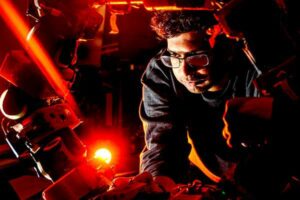
Salagame working on the Cobra robot. Courtesy Photo
A particular project Salagame is proud of is the snake robot, called Cobra, from the Silicon Synapse Lab. This project began as a NASA competition entry for exploring moon craters, resulting in a multi-jointed robot able to climb in and out of craters. From there, they expanded its purpose to access any unknown environment they wish to study.
Because the robot stays low to the ground, it has no risk of tipping over, and can navigate challenging surfaces like sand. Salagame’s research involved designing the controls and sensors for this robot. With multiple points of contact on the ground, predicting the robot’s movement is complex— Salagame had to model the physics of these interactions to determine how the joints should move. The research also involved integrating sensors and cameras to help the robot localize itself within its environment.
Co-op and Caltech
Salagame completed a co-op during his master’s at the Woods Hole Oceanographic Institute for robotics engineering. He was originally introduced by the MS in Robotics program director and professor, Hanumant Singh, who had worked there before joining Northeastern. There, Salagame worked with underwater robots—a particularly novel experience for someone who grew up in a landlocked city. He learned to navigate the unique challenges of underwater robotics, where robots often cannot be maintained, accessed, or communicated with for hours or days at a time. The experience proved invaluable, and he brought the knowledge he gained back to his lab at Northeastern.
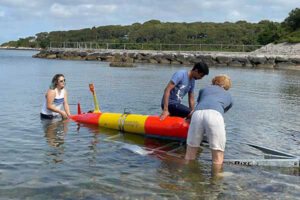
Salagame and his team working on an aquatic robot at Woods Hole. Courtesy Photo
Another formative experience came when Salagame spent time as a visiting student researcher at Caltech. The opportunity arose through Professor Ramezani, a prominent figure in robotics, who was a visiting faculty member there at the time. Salagame and Ramezani collaborated with Caltech’s robotics lab on a wheeled drone project, tweaking aspects of the robot and presenting a demo to the Caltech community. This ongoing collaboration strengthens his skills in robotic controls and left a lasting impression.
Learning and mentorship
Salagame’s PhD journey has taught him the importance of pushing beyond his comfort zone. As he puts it, “if you’re within your comfort zone, you’re doing the PhD wrong.” He’s learned not to shy away from unfamiliar topics, but to jump right in and to trust his capabilities. He credits Professor Ramezani with continuously pushing him beyond what he thought possible. Reflecting on this mentorship, Salagame says, “Now I am doing things I didn’t think I would have been able to do four years ago.”
Another mentor he is grateful for is Professor Singh. Before he joined Professor Ramezani’s lab during his master’s, Salagame took courses with Professor Singh and first turned to him for research guidance. Salagame explains that “he’s very good at zooming out and helping you understand robotics at the system level, focusing on what’s really important.” The classes he took with Singh showed him a new perspective on how robotic systems come together, and Salagame has gained valuable insight from Singh’s coursework and mentorship over the years.
Salagame is grateful for his mentors and the resources Northeastern has provided. The open floor plan and collaboration among PhD students at EXP have helped shaped his vision for his future career. Thanks to the perseverance and skills he’s developed, Salagame plans to continue working in a multidisciplinary, collaborative, and rigorous research environment—much like Northeastern—after completing his PhD in 2027.