The Future of Space Computing and the Hurdles for Orbital AI
Tech giants like Google, SpaceX, and Blue Origin are racing to develop orbital AI data centers to bypass terrestrial energy and land constraints, though ECE Professor & Associate Dean for Research Josep Jornet warns that significant hurdles regarding power, radiation, and heat dissipation must be solved before these systems become operational.
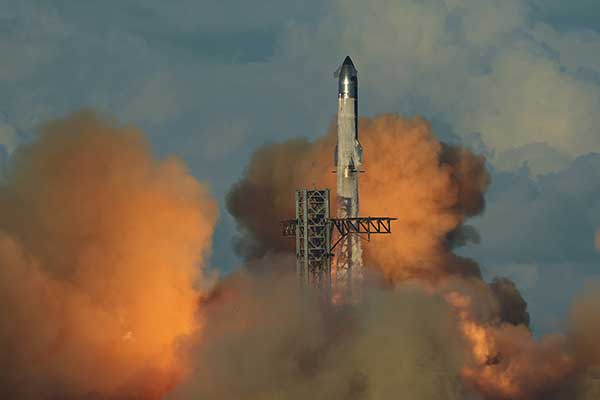
This article originally appeared on Northeastern Global News. It was published by Cesareo Contreras. Main photo: SpaceX’s mega rocket Starship makes a test flight from Starbase, Texas, Monday, Oct. 13, 2025. AP Photo/Eric Gay
The next great space race: Building data centers in orbit
Northeastern experts say that while early work on AI data centers in space may be ongoing, don’t expect them soon.
Google, SpaceX and Blue Origin are reportedly racing to develop technology for AI data centers in space, but it will likely be years before we see them rocketing into the sky, experts say.
“I don’t think we’ll have an operative data center in space in the next couple of years, but we’ll start seeing some of the building blocks tested in the next couple of years,” said Josep Jornet, a computer and electrical engineering professor at Northeastern University and satellite researcher.
The thinking goes that space isn’t bound by the same constraints as Earth, where energy demands and environmental impacts can be extraordinally high.
According to the International Energy Agency, or IEA, a typical AI data center on Earth consumes annually as much electricity as 100,000 households, and energy impacts are only expected to rise to accommodate the development of larger and more complex AI models.
There is concern that there isn’t enough energy to go around. In 2024, the IEA reported that energy demands from data centers and AI will likely more than double from 460 terawatt-hour (TWh) of electricity in 2022 to more than 1,000 TWh by 2026, which it said is “roughly equivalent to the energy consumption of Japan.”
Space data centers, by contrast, would instead be equipped with solar-panel-equipped satellites designed to harness power directly from the sun, offset heat into space, and not be limited by available land.
Fewer data centers on the ground would also potentially help lighten the load on communities like Loudoun County in Northern Virginia, which has been given the nickname “Data Center Alley” for being home to the largest data center hub in the country with over 250 operational facilities.
“Think of space as the next frontier to conquer,” added Jornet. “There was a gold rush in the West. Now there is the space rush, and everyone wants to put their technology in space.”
SpaceX’s and Blue Origin’s space data center plans were reported in December by The Wall Street Journal.
Blue Origin has a dedicated team working on creating the technology to support AI data centers in space, the Journal reported. While SpaceX is working on modifying and upgrading its rockets to be better to “host AI computing payloads.”
SpaceX and Blue Origin have not publicly commented on the Wall Street Journal’s reporting and did not respond to Northeastern Global News’ request for comment.
But both Elon Musk and Jeff Bezos have in the past talked about building AI data centers in space.
They are not the only ones.
In November, Google, through its moonshot Project Suncatcher, announced its plan to launch two test satellites with its AI processing chips in 2027 in partnership with Planet Labs, an American satellite company.
Read full story at Northeastern Global News