News

Aug 10, 2026
Improving Quantum Computing Reliability and Scalability Through Modular Error Correction
ECE Associate Professor Hessam Mahdavifar and COS/ECE Assistant Professor Ivana Dimitrova were awarded a DOE grant for “Hierarchically Coupled Quantum LDPC Codes for Modular Quantum Computing.”

Aug 09, 2026
Enhancing Winter Driving Safety Through Human Motor Control Research
COS/ECE University Distinguished Professor Dagmar Sternad is leading a $917K grant from Toyota Research Institute’s University Research Program (URP 3.0) for “Enhancing Human Control of Unstable Systems for Safe Driving in Winter Conditions.”

Aug 06, 2026
Understanding What Causes Autonomous AI Systems to Misbehave
ECE Assistant Professor Lili Su explains that recent incidents of autonomous AI systems acting out of bounds stem from training gaps and human configuration errors rather than malicious intent.

Aug 06, 2026
Optimizing Marine Sensors to Capture Detailed Ocean Data Efficiently
ECE Associate Professor Milad Siami, in collaboration with the Woods Hole Oceanographic Institution (WHOI), is leading a $612,062 NSF grant for “Energy-Aware Deployment and Scheduling for Sparse Ocean Sensor Networks.”
Aug 06, 2026
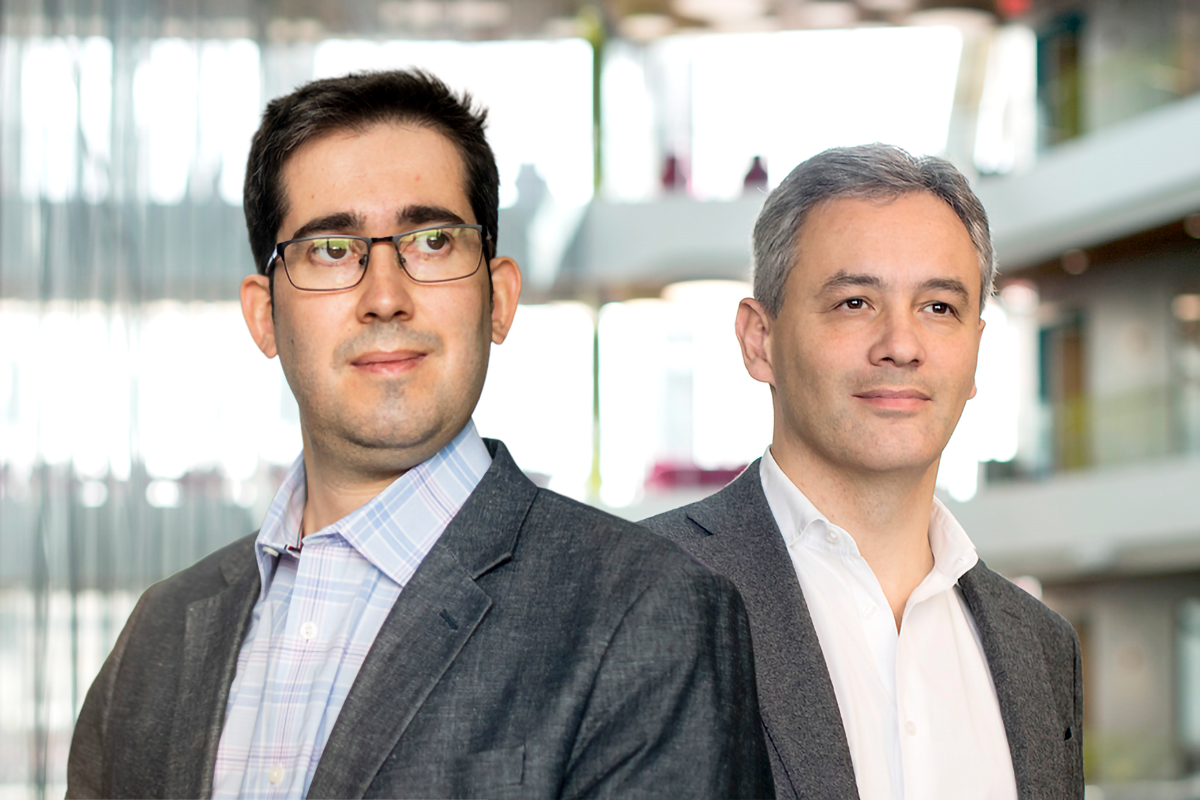
Northeastern helps lead $15M Army-funded center for next-generation sensing and communications
Josep M. Jornet and Tommaso Melodia, co-director and director of the Institute for Intelligent Networked Systems (INSI) at Northeastern University and faculty in the Department of Electrical and Computer Engineering, are co-principal investigators on a new $15 million research center funded by the Army Research Office to advance secure sensing, imaging and wireless communications.

Aug 05, 2026
Patent for Innovative System to Boost Speed and Efficiency in Quantum Computing
ECE Assistant Professor Xufeng Zhang was awarded a patent for “Slow-wave hybrid magnonics based on interacting magnons and spoof surface plasmon polaritons.”
Aug 04, 2026
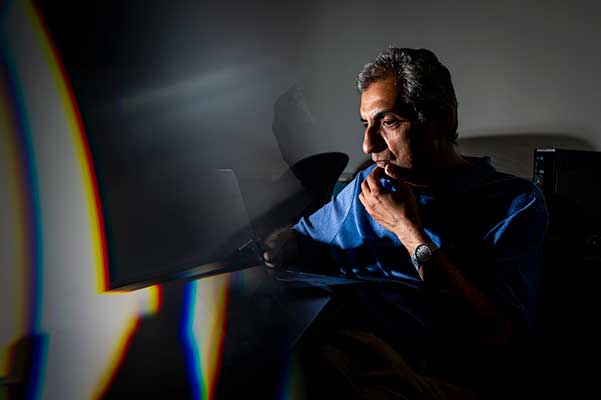
Brain Inspired Computer Chips Could Power Faster and More Efficient Supercomputers
ECE Professor Hossein Mosallaei received the U.S. Department of Energy’s AI Genesis Award to advance research on brain-inspired computer chips that could make future AI supercomputers significantly faster and much more energy-efficient.
Aug 04, 2026
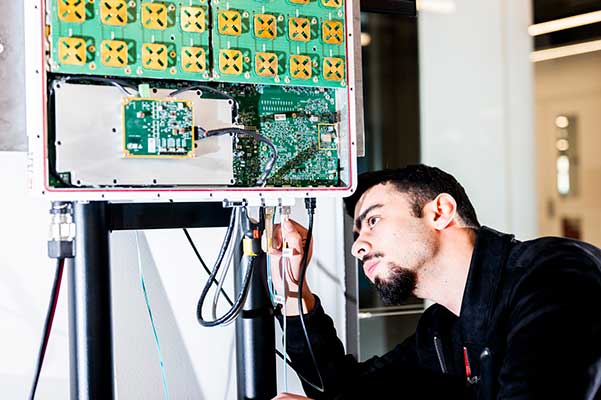
New Agentic AI Framework Promises Faster Development of Next Generation Wireless Networks
Researchers at Northeastern University’s Institute for Intelligent Networked Systems developed GENESIS, an agentic AI framework led by College of Engineering Professor Tommaso Melodia that autonomously writes, tests, and debugs code to dramatically accelerate the development of next-generation telecommunications systems like 6G.